
YouTube Sponsorships: 2026 Rates by Channel Size
YouTube sponsorships typically pay $10 to $50 per 1,000 views. See 2026 rate tables by channel size and niche, a floor-rate formula, and 6 red flags.
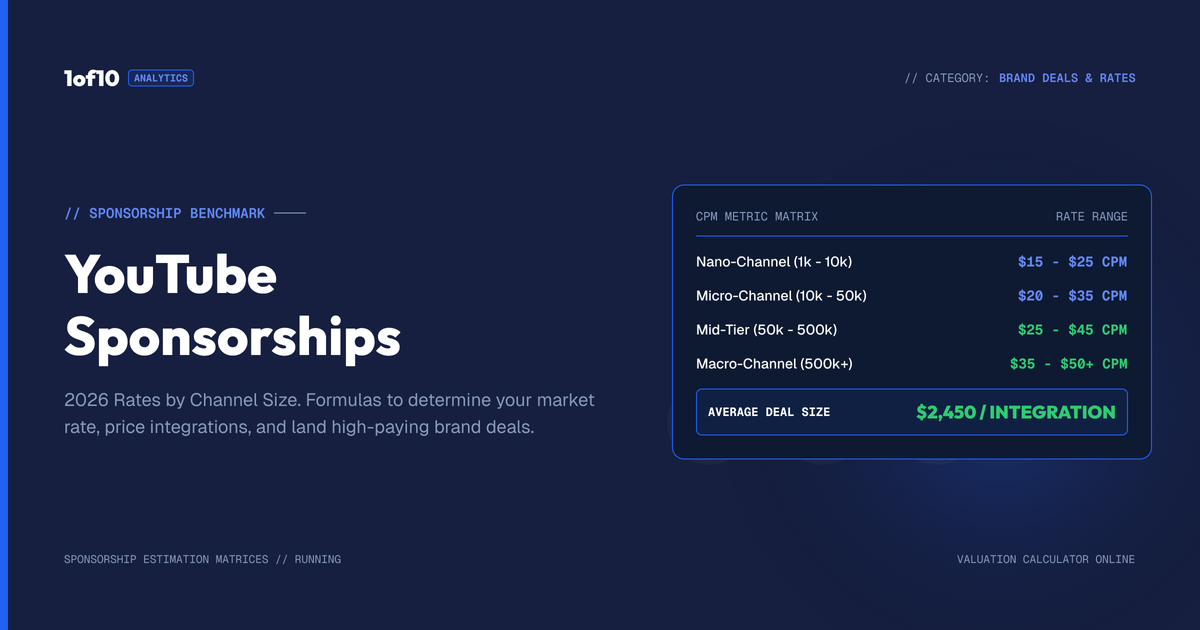
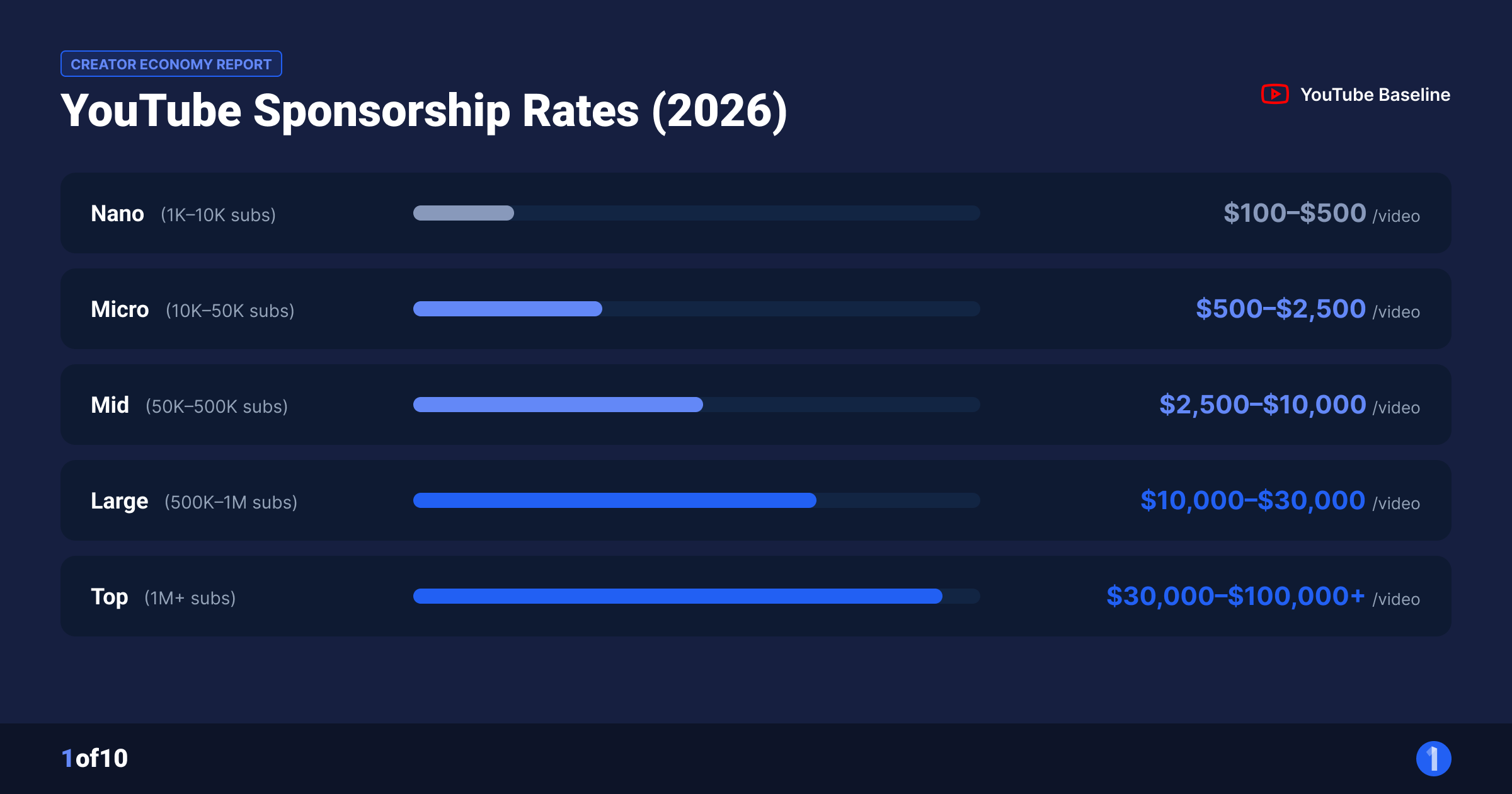
YouTube sponsorships typically pay $10 to $50 per 1,000 expected views for a dedicated integration, based on publicly reported creator rate data. A channel averaging 25,000 views per video can reasonably quote $500 to $1,250 for a 60-second integration, while finance and B2B channels command the top of every range.
Those are the benchmarks. This post is about rates only: what brands pay, how deals are priced, and where your floor should sit. If you need sponsors first, read our guide on how YouTubers can get more sponsorships, then come back here before you quote a number.
One market fact frames everything below: influencer marketing passed an estimated $24 billion in annual spend according to Influencer Marketing Hub's benchmark report, and YouTube takes a growing share of it because video integrations outperform static posts on conversion. Brands have budget. Most creators just quote too low.
How Does YouTube Sponsorship Pricing Work?
Almost every YouTube sponsorship prices off one of three models: CPM-based (a rate per 1,000 expected views), flat fee per video, or a hybrid with a flat base plus performance bonuses. CPM-based pricing dominates because it ties the brand's spend to delivered attention, and it is the model you should anchor your own quotes to.
The three models in practice:
- CPM-based. Brand pays an agreed rate per 1,000 views, usually estimated from your recent median views, sometimes trued up after 30 days. Typical sponsorship CPMs run $10 to $50 depending on niche, a range widely reported across creator rate surveys and sponsorship marketplaces.
- Flat fee. One number for the video, negotiated up front. Simple, but it transfers all performance risk. Price flat fees off your median views, never your best video.
- Hybrid. Flat base plus a bonus per signup, sale, or view milestone. Common with app and SaaS sponsors who track everything.
Three contract variables move the final number as much as the base rate does:
- Usage rights. Can the brand run your clip as a paid ad? That is a separate license, typically priced at +30 to +100 percent of the base fee.
- Exclusivity. Agreeing not to work with competitors for 30 to 90 days removes future revenue, so it costs extra: +20 to +50 percent is a typical band.
- Deliverable scope. Link in description, pinned comment, and a community post are add-ons, not freebies.
Note that sponsored content carries legal obligations: disclosure under the FTC's endorsement guides and YouTube's paid product placement flag per YouTube's policy. Brands expect both. Neither reduces your rate.
YouTube Sponsorship Rates by Channel Size
Channel size sets the starting band, and views matter more than subscribers inside it. Brands buy expected views, so a 40,000-subscriber channel averaging 60,000 views per video out-earns a 200,000-subscriber channel averaging 15,000. The per-video figures below are typical ranges for a dedicated integration, compiled from public creator-reported rates and marketplace listings.
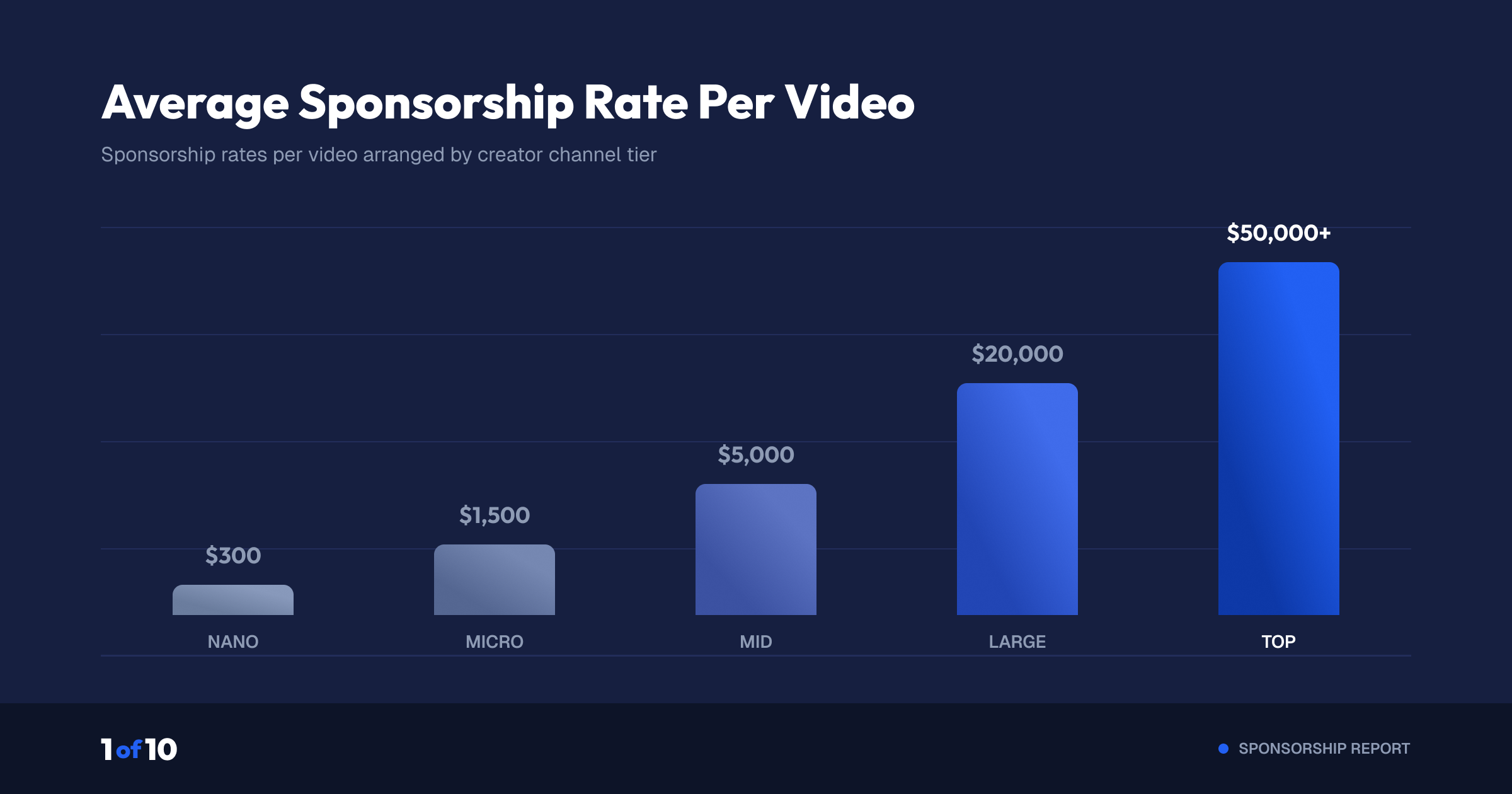
| Channel tier | Subscribers | Typical rate per sponsored video |
|---|---|---|
| Nano | 1K to 10K | $50 to $500, often product plus fee |
| Micro | 10K to 50K | $200 to $1,500 |
| Mid | 50K to 500K | $1,000 to $10,000 |
| Large | 500K to 1M | $5,000 to $20,000 |
| Top | 1M+ | $10,000 to $100,000+ |
How to read this table:
- The ranges are wide because niche and average views vary wildly inside each tier. A 30,000-subscriber finance channel can out-quote a 300,000-subscriber gaming channel.
- Nano deals skew toward product-plus-fee. Free product alone is not payment; see the red flags section.
- Above 1M subscribers, deals become bespoke. Multi-video packages, ambassadorships, and agency negotiation take over.
among outlier videos, channels under 1,000 subscribers still pull a median 2,000+ views, and the 1,000 to 100,000 tier medians around 5,500.
YouTube Sponsorship Rates by Niche
Niche moves sponsorship CPMs the same way it moves ad CPMs: brands pay for buyer intent. A viewer researching brokerage accounts is worth more per impression than a viewer watching gameplay, and sponsor budgets reflect it. Typical sponsorship CPM ranges by niche, from public creator rate surveys:
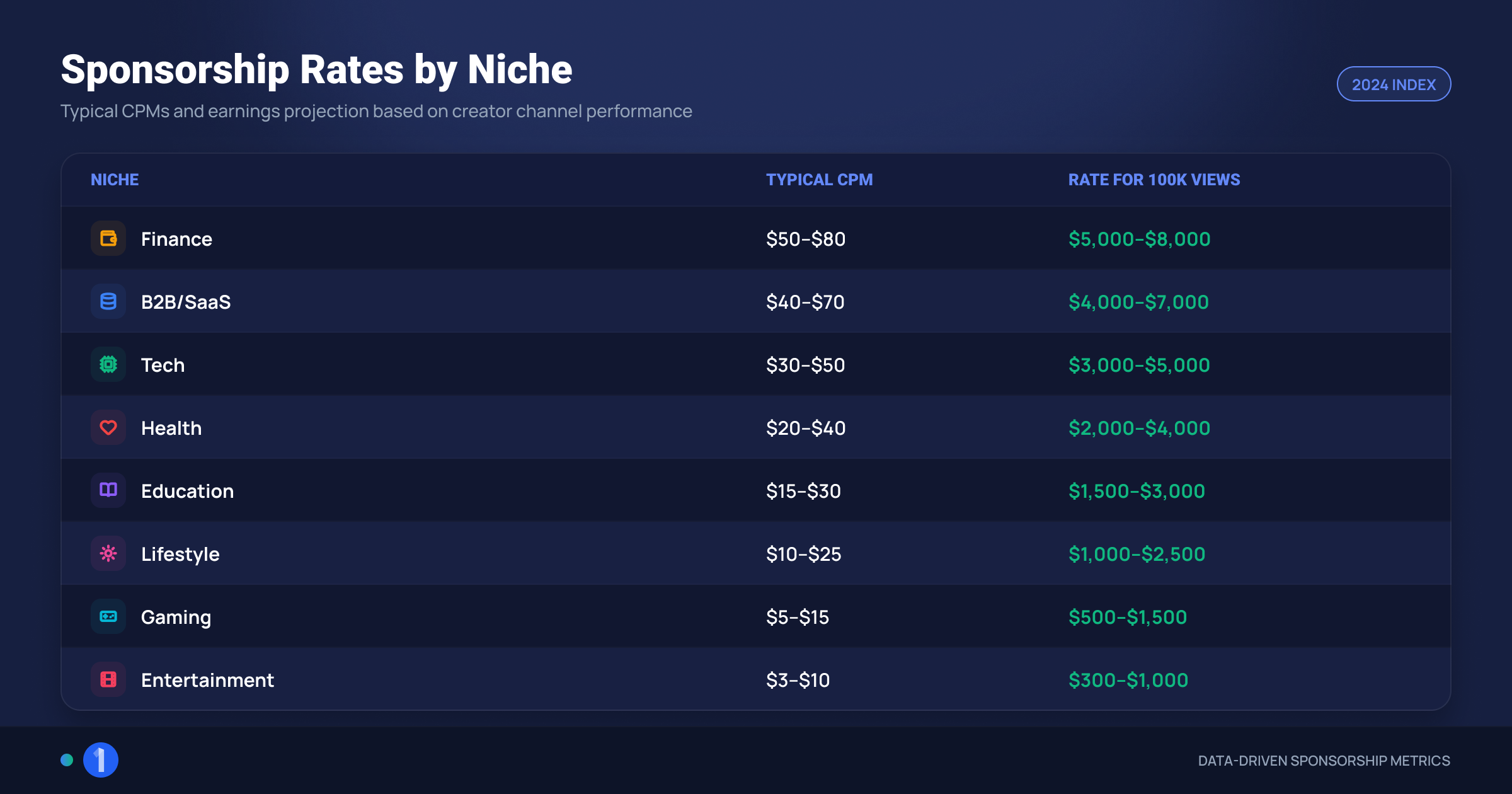
| Niche | Typical sponsorship CPM (per 1,000 views) |
|---|---|
| Finance and investing | $35 to $50+ |
| B2B, SaaS, and tech | $30 to $50 |
| Business and marketing | $25 to $40 |
| Education | $20 to $35 |
| Health and fitness | $18 to $30 |
| Beauty and fashion | $15 to $25 |
| Food and cooking | $12 to $22 |
| Travel | $12 to $20 |
| Gaming | $10 to $20 |
| Entertainment and vlogs | $8 to $15 |
Two patterns worth noting:
- Sponsorship CPMs run above AdSense CPMs in every niche, because a 60-second endorsement from a trusted creator converts better than a skippable pre-roll.
- Low-AdSense niches close the gap here. Gaming and entertainment channels often earn 3 to 5x more from sponsors than from ads, the reverse of finance channels. Pair this table with our YouTube CPM and RPM by niche breakdown to see both revenue streams side by side.
What Does Each Integration Type Pay?
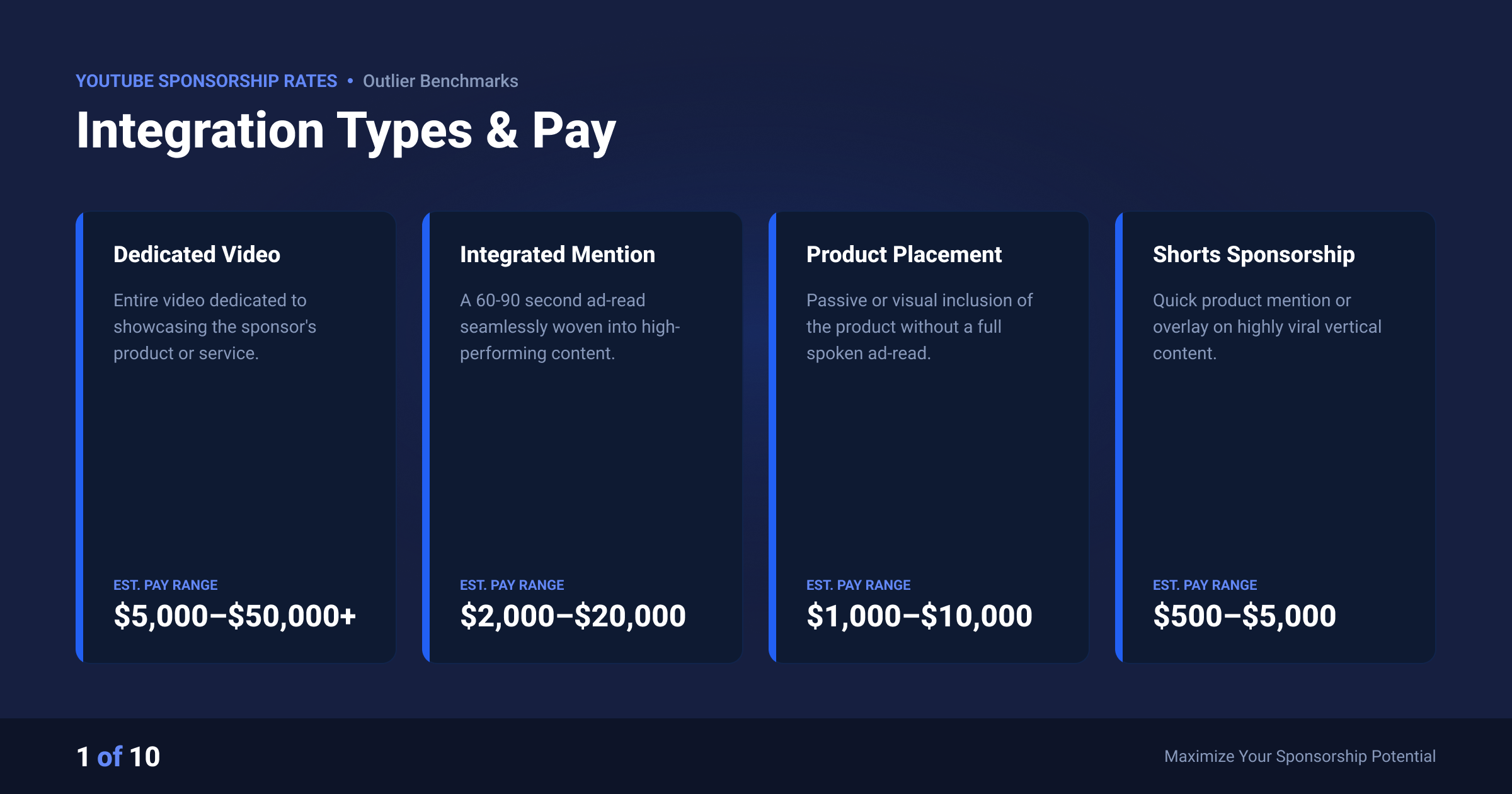
Not all sponsored placements cost the same. A dedicated video is the premium product, a 60-second integration is the standard unit, and Shorts and community posts price at a steep discount. Typical pricing relative to your base integration rate:
| Integration type | Typical pricing vs 60s integration |
|---|---|
| 60 to 90 second integration | Baseline (1.0x) |
| Dedicated video | 2x to 4x baseline |
| 30 second mention or pre-roll style shoutout | 0.5x to 0.7x |
| Sponsored Short | 0.25x to 0.5x |
| Community post | 0.1x to 0.2x |
| Description link plus pinned comment (add-on) | +5 to +10 percent |
Rules of thumb:
- Dedicated videos carry production cost and audience risk (a full ad video can underperform), so 2x is a floor, not a target.
- Sponsored Shorts price low per unit but bundle well: three Shorts plus one integration is a common package.
- Never sell the description link separately for free. Everything the brand receives has a line item.
What Raises YouTube Sponsorship Rates?
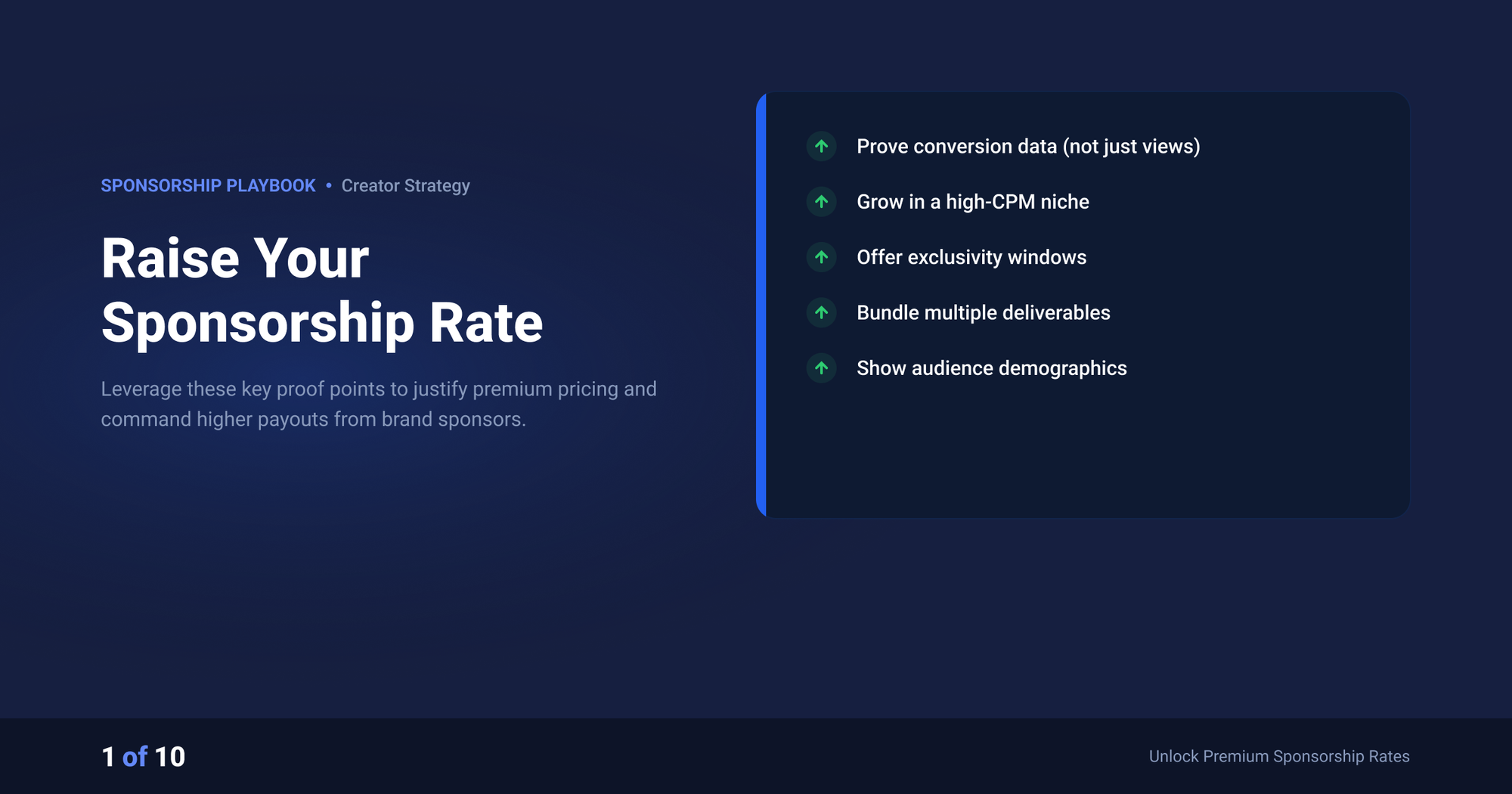
Brands pay premiums for three things: an audience with buyer intent, viewers in high-value countries, and predictable views. The first two are set by your content strategy. The third is the one most creators underweight, and it is where consistency becomes money.
The levers, in order of impact:
- Buyer-intent niche and formats. Review, comparison, and "best X for Y" formats signal purchase-ready audiences. Sponsors pay the top of the niche band for them.
- Audience geography. A majority-US or UK audience supports top-of-band CPMs. The geo multipliers that govern ad rates apply to sponsorship pricing too.
- View consistency. A channel that reliably delivers 20,000 to 30,000 views per video is easier to buy than one that swings from 5,000 to 150,000. Brands discount volatility. This is where outlier research earns twice: studying proven formats with 1of10's Outlier Finder before you publish raises your median, not just your ceiling, and the median is what sponsors price. Channels that repeat proven outlier formats hold their view counts far more consistently than one-hit uploads.
- Engagement quality. Comment depth and returning-viewer rate show up in brand reporting. High engagement justifies quoting above band.
- Professional delivery. Media kit, on-time drafts, clean usage terms. Repeat sponsors pay more than new ones, and repeats come from process.
Monetization status is not required for sponsorships, but it signals audience scale. If you are pre-monetization, our YouTube Partner Program guide covers the thresholds worth hitting anyway.
How to Calculate Your Floor Rate (Formula + Examples)
Your floor rate is the number below which a deal loses you money or mispricing your attention. Calculate it before any negotiation: median views of your last 10 videos, times your niche's sponsorship CPM, divided by 1,000, plus your production cost for the deliverable.
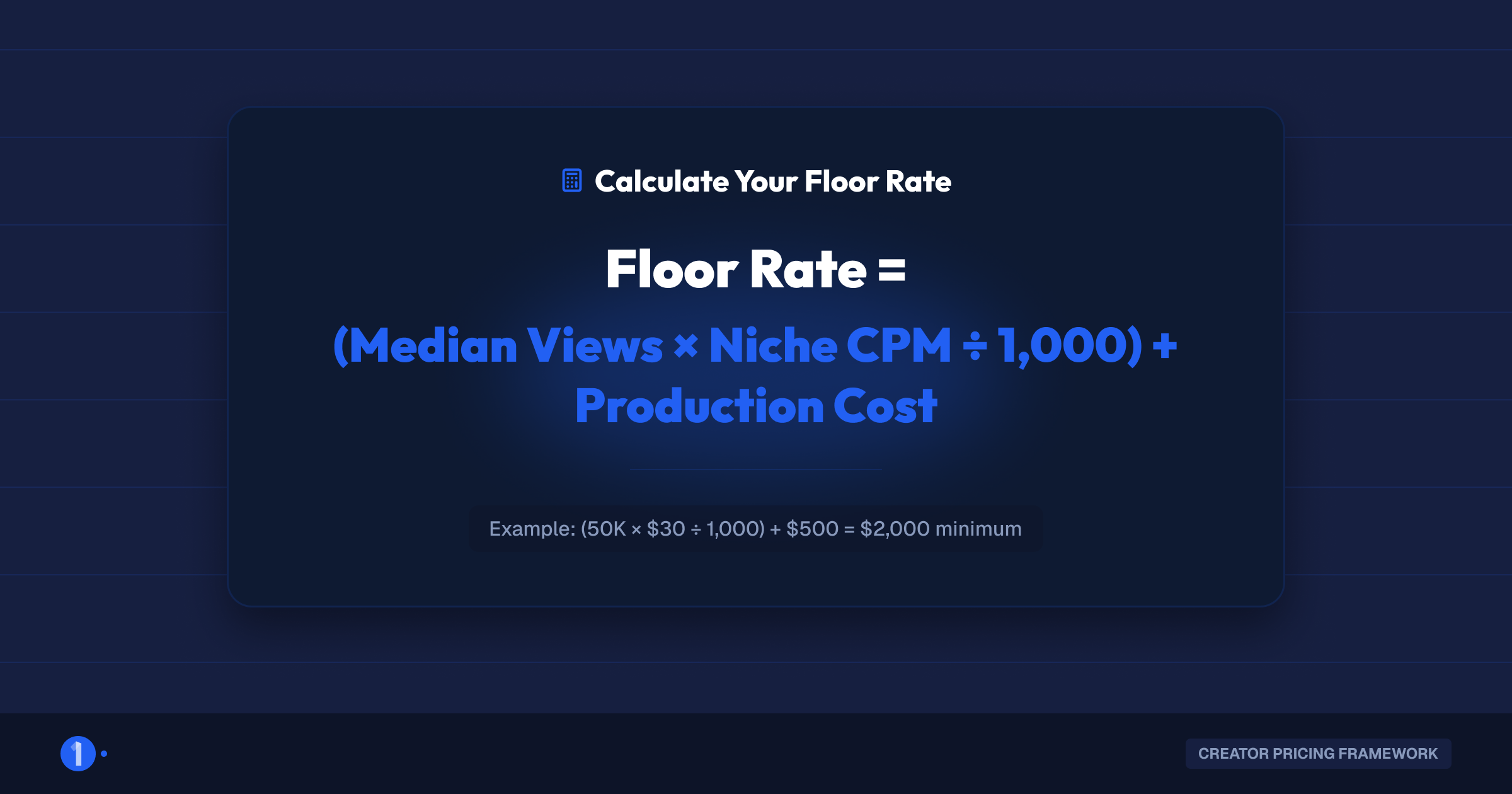
Floor rate = (median views of last 10 videos × niche CPM ÷ 1,000) + production cost
Use the median, not the average. One outlier video inflates an average and sets you up to underdeliver.
Worked example 1, micro gaming channel:
- Median views, last 10 videos: 18,000.
- Gaming sponsorship CPM, low end: $12.
- Attention value: 18,000 × $12 ÷ 1,000 = $216.
- Production cost for a 60-second integration: $80 of edit time.
- Floor: roughly $300. Quote $400 to $450 and leave room to negotiate down.
Worked example 2, mid-size finance channel:
- Median views: 60,000.
- Finance sponsorship CPM, mid band: $40.
- Attention value: 60,000 × $40 ÷ 1,000 = $2,400.
- Production cost: $300.
- Floor: $2,700. A dedicated video for this channel starts near $5,500 (2x baseline).
Estimate what your total attention is worth across ads and sponsorships with our YouTube earnings calculator guide, and run quick per-view math with the free YouTube money calculator.
Sponsorship Red Flags: Terms That Cost You Money
Bad terms cost more than low rates. A $2,000 deal with perpetual usage rights can be worth less than a $1,200 deal without them, because the brand runs your face as an ad for years on a one-time fee. Six clauses to catch before signing:
- Free product as full payment. Product-only deals are only rational when the product's retail value exceeds your floor rate and you would have bought it anyway. Otherwise it is a discount, not a fee.
- Perpetual or unlimited usage rights. Usage should be scoped: which platforms, paid or organic, and for how long (90 days to 12 months is normal). Perpetual rights cost a large multiple of base, if you sell them at all.
- MFN clauses. "Most favored nation" terms lock you into giving this brand your lowest rate forever. They cap every future negotiation. Strike them or price them.
- Unpaid exclusivity. Any restriction on working with competitor brands is lost revenue and must be paid for. Never accept exclusivity as a default contract line.
- Unlimited revisions. Cap revisions at one or two rounds. Unbounded revision clauses turn a $500 deal into $200-an-hour-negative work.
- Payment after performance. Net-30 from publish date is standard. "Payment after the video hits X views" is the brand renting your audience for free.
Flat Fee or CPM: Which Should You Quote?
Quote a flat fee calculated from CPM math when your views are stable, and push for CPM-based or hybrid pricing when your channel is growing fast. The right structure depends on who benefits from variance. Stable channels convert predictability into a clean number; growing channels get paid for upside instead of giving it away.
How to choose:
- Views stable within about 30 percent of median: quote flat. Brands prefer it, you close faster, and your median already prices the risk.
- Channel growing month over month: quote a flat base at your floor plus a CPM top-up on views above median, trued up at day 30. If the video runs 3x median, you get paid 3x-ish, not 1x.
- Volatile channel, big swings both ways: offer capped CPM pricing (a per-1,000 rate with a spend ceiling). The cap gets risk-averse brands to yes without you discounting.
- Brand insists on performance-only (affiliate or per-sale): treat it as a red flag unless the base fee still clears your floor. Pure performance deals shift all risk onto you.
One more structural note: true-ups need a measurement window in writing. "Views at 30 days post-publish, per YouTube Studio" is standard. Without a window, a brand can argue lifetime views or a screenshot date that suits them, and your bonus clause becomes decorative.
Whichever structure you pick, the floor-rate formula above stays the anchor. Structure changes how the money arrives, not how much your attention is worth.
Negotiation Benchmarks: What to Add and When
Every extra ask has a market-normal price. Anchor with your floor rate, quote 20 to 30 percent above it, and then price add-ons from typical bands rather than inventing numbers under pressure.
Benchmarks creators commonly apply, labeled as typical ranges:
- Paid usage rights (whitelisting): +30 to +100 percent of base, scoped by duration and platform.
- Category exclusivity, 30 days: +20 to +30 percent. 90 days: +50 percent or more.
- Rush delivery under 7 days: +25 to +50 percent.
- Multi-video packages: 10 to 20 percent discount per video in exchange for committed volume. Never discount a single video.
- Renewals: repeat campaigns typically renew at or above the prior rate. If the first video performed, quote up 10 to 20 percent, with the performance data attached.
Bring receipts to every negotiation: median views, audience geo split, engagement rate, and past sponsor results. Brands move on evidence, not vibes. And keep pipeline pressure on your side by tracking which competitors' videos are breaking out with 1of10's Tracked Channels: a creator who knows the niche's winning formats this month negotiates from strength.
FAQ
How much should I charge for a YouTube sponsorship?
Charge your floor rate plus margin: median views of your last 10 videos, times your niche's typical sponsorship CPM ($10 to $50 per 1,000 views), divided by 1,000, plus production cost. Quote 20 to 30 percent above that floor to leave negotiation room. A channel with a 25,000-view median in a $20 CPM niche quotes around $650.
How much do sponsors pay per 1,000 views on YouTube?
Sponsors typically pay $10 to $50 per 1,000 expected views for an in-video integration, based on publicly reported creator rates. Finance and B2B channels sit at $30 to $50, gaming and entertainment at $8 to $20. Dedicated videos price at 2x to 4x those figures, and Shorts at a quarter to half.
How many subscribers do you need to get YouTube sponsorships?
There is no threshold. Brands buy views and audience fit, not subscriber counts, and nano channels with 1,000 to 10,000 subscribers land product-plus-fee deals in niches with strong buyer intent. Consistent views matter more: a reliable 10,000 views per video is sellable. Our guide on getting more sponsorships covers the outreach side.
Do YouTube sponsorships pay more than AdSense?
Usually, yes. Sponsorship CPMs of $10 to $50 per 1,000 views run well above typical creator RPMs of $1 to $20, and in low-ad-rate niches like gaming and entertainment, sponsors often out-pay AdSense 3 to 5x. Compare both streams for your niche in our CPM and RPM by niche breakdown.
Should I accept free product as payment for a sponsorship?
Only when the product's retail value clearly exceeds your floor rate and you genuinely want it. Free product costs the brand wholesale price, not retail, so they are paying you cents on the quoted dollar. Counter with product plus a fee. If a brand has an influencer budget for product, it has one for cash.
CTA block: Sponsors pay for predictable views, and predictable views come from proven formats. 1of10 shows you the videos in your niche performing 10x their channel average right now, so your median climbs and your rate card follows. Try 1of10 free.