
How Much Does YouTube Pay Per View? Real 2026 Numbers
YouTube earnings per 1,000 views run $1 to $20 depending on niche. See typical per-view rates, RPM tables by niche and country, and worked examples.
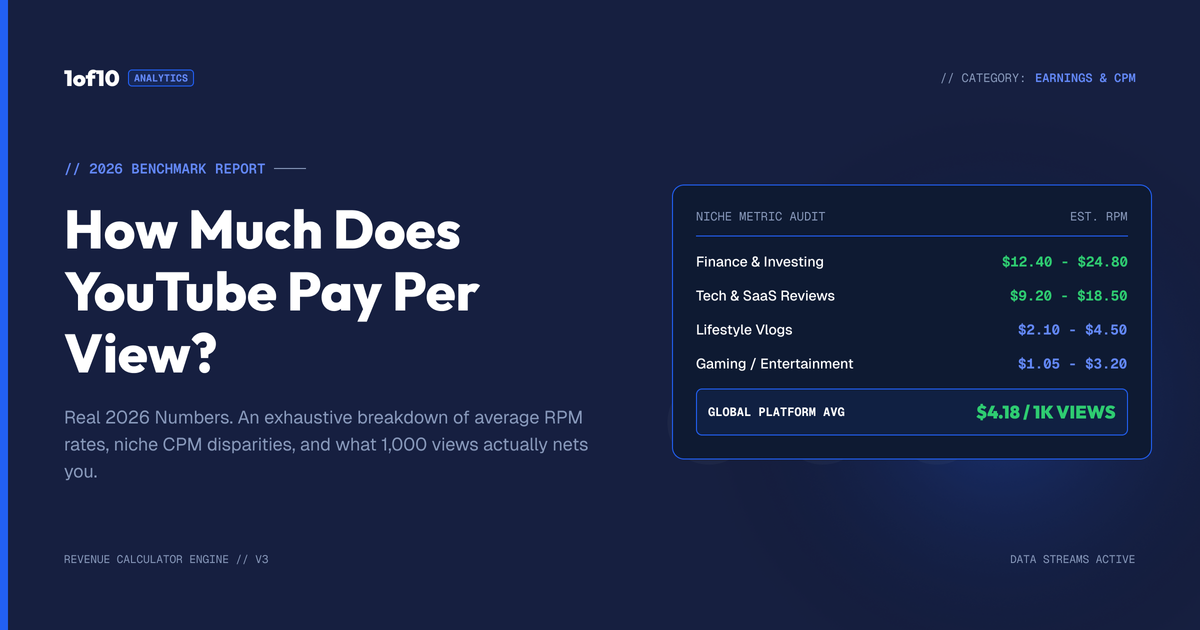
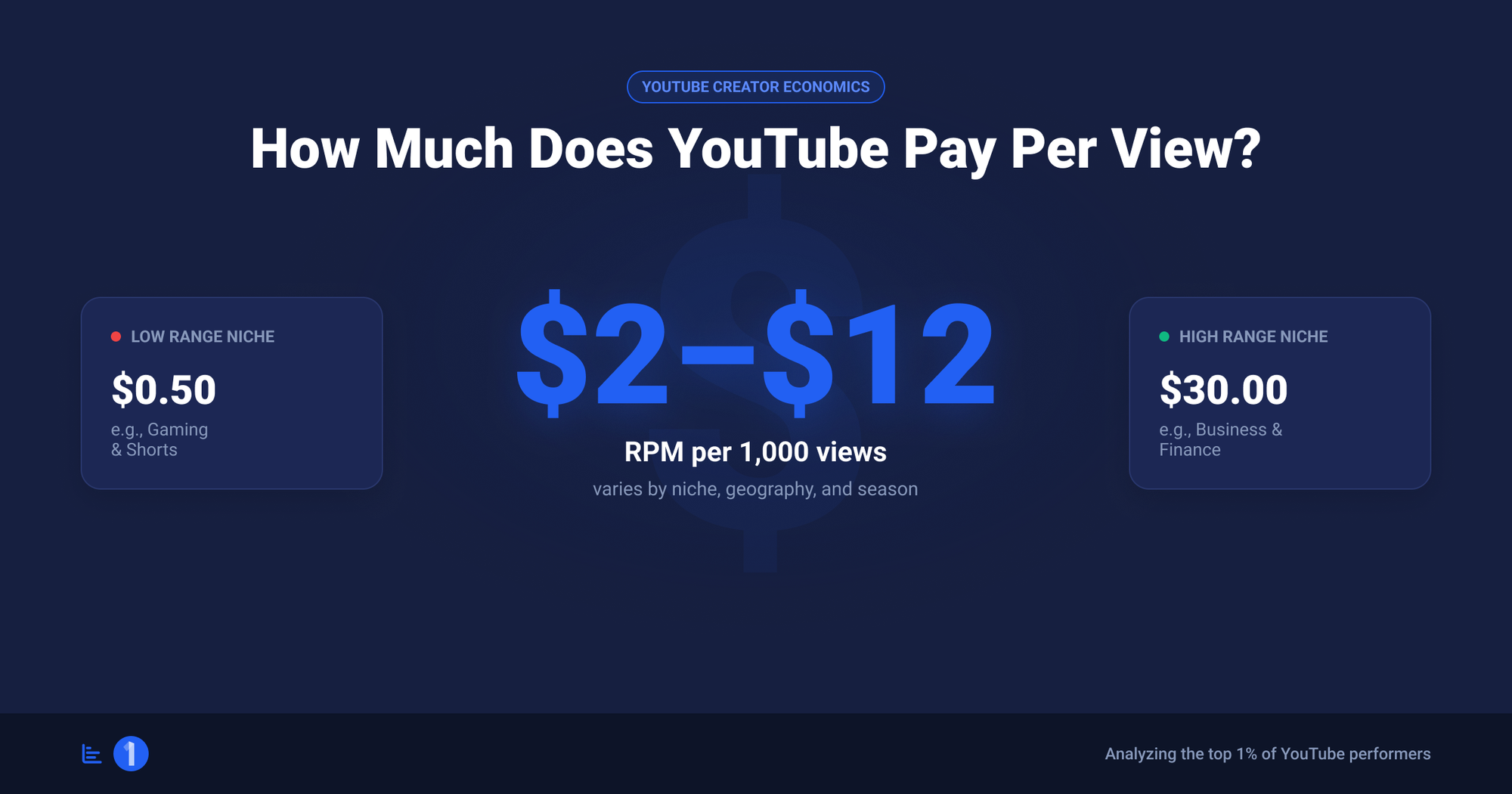
YouTube pays roughly $0.001 to $0.02 per view on long-form videos. In the metric creators actually use, that is earnings per 1,000 views (RPM) of $1 to $20, with most channels sitting between $2 and $5. Shorts pay far less: typically under a cent per view from the Shorts Creator Pool. These are typical creator-reported ranges; the revenue splits behind them are official YouTube policy.
That is the honest answer, and the spread is the story. The same 100,000 views pay one channel $150 and another $1,500. This guide shows exactly where in that range you land and why: the CPM versus RPM mechanics, rate tables by niche and country, Shorts rates, what moves your number month to month, and worked examples you can copy. To model your own channel in seconds, use our free YouTube money calculator.
Earnings per 1,000 views on YouTube: the quick reference
Per-view numbers have too many zeros to think in, so YouTube and creators both use per-1,000 figures. Your earnings per 1,000 views on YouTube is your RPM, short for revenue per mille. It is total revenue divided by total views, times 1,000, and YouTube defines it officially here.
The quick reference, using typical creator-reported ranges:
| Content type | Typical earnings per 1,000 views | Typical per view |
|---|---|---|
| Long-form, high-value niche (finance, business) | $10 to $30 | $0.01 to $0.03 |
| Long-form, mid niche (education, tech, health) | $3 to $10 | $0.003 to $0.01 |
| Long-form, entertainment niches (gaming, vlogs, music) | $1 to $5 | $0.001 to $0.005 |
| Shorts (all niches) | $0.04 to $0.15 | well under a tenth of a cent |
Two ground rules before the deep tables:
- Only monetized channels earn anything. You need acceptance into the YouTube Partner Program first. Requirements and application steps are in our YouTube Partner Program guide.
- Payouts start at $100. AdSense holds earnings until you cross the $100 threshold, then pays monthly.
CPM vs RPM: the two numbers people confuse
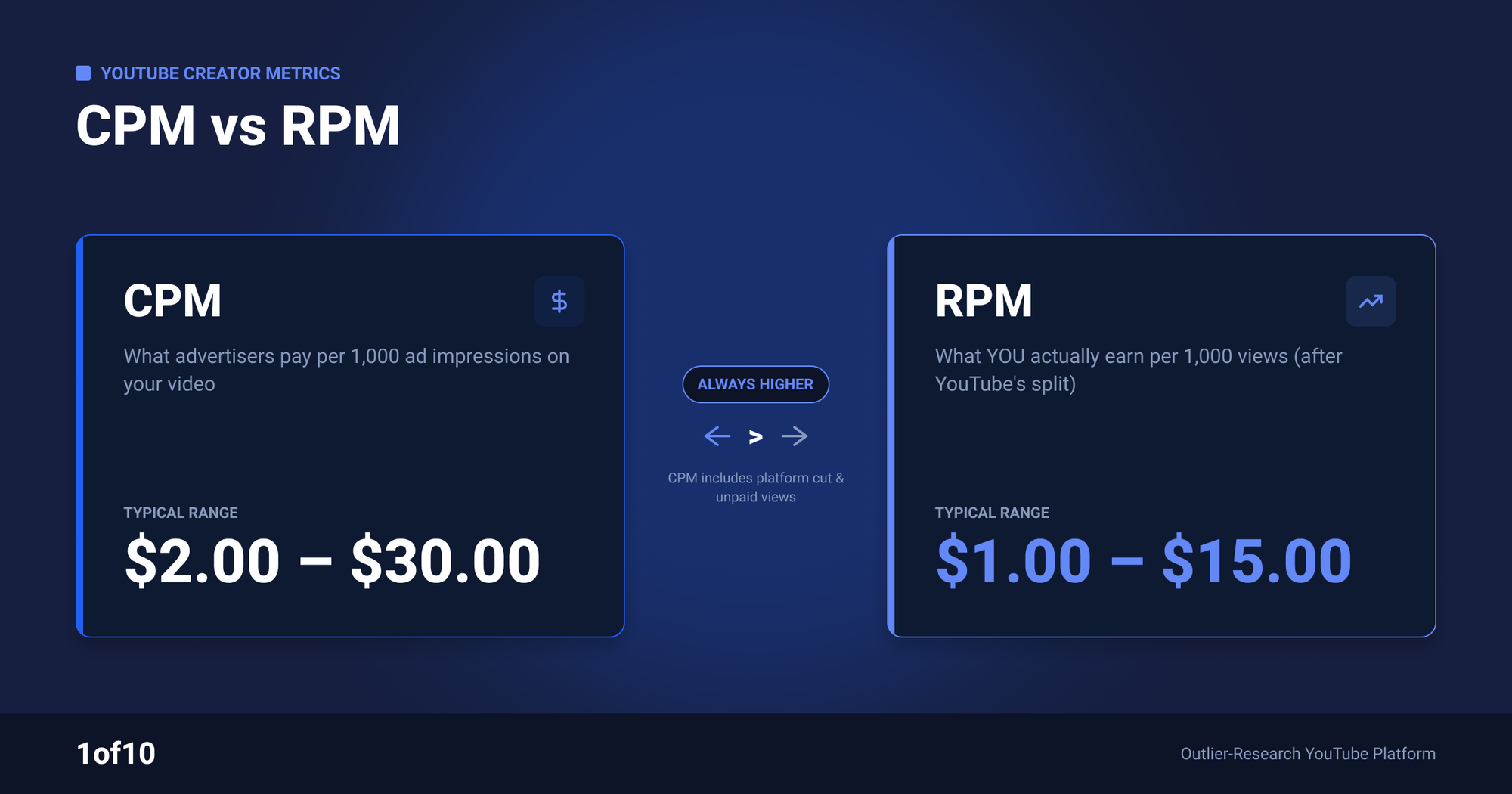
Half the bad per-view math on the internet comes from mixing up CPM and RPM. They measure different ends of the same transaction.
CPM is the advertiser side: what brands pay YouTube per 1,000 ad impressions. RPM is your side: what you actually receive per 1,000 video views, after YouTube's share and after all the views that showed no ad.
RPM lands well below CPM for two stacked reasons:
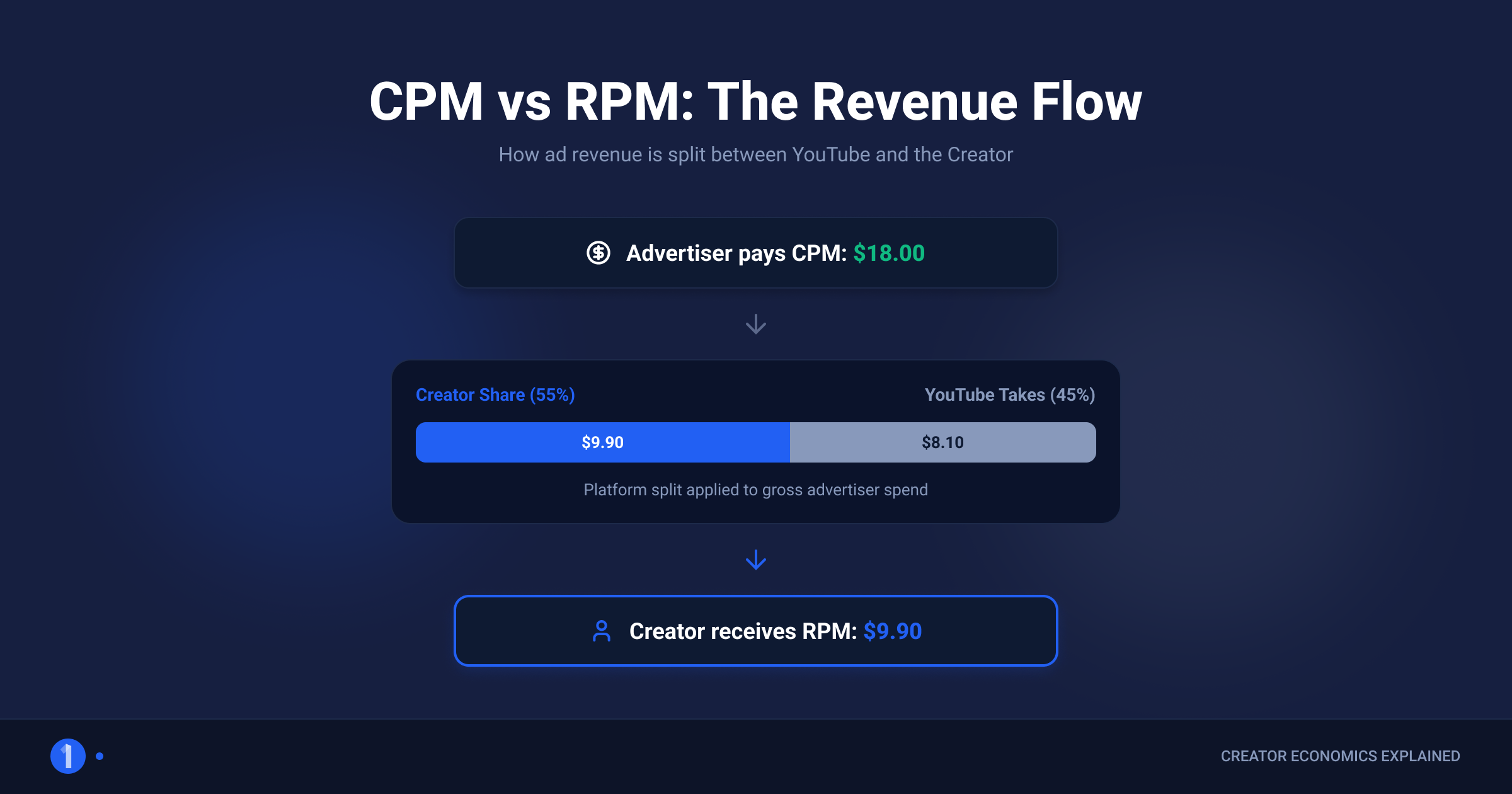
- The revenue split. You keep 55% of ad revenue on long-form videos and YouTube keeps 45%, per the official payment terms. On Shorts, you keep 45% of your allocation from the Shorts Creator Pool.
- Unmonetized views. Not every view shows an ad. Ad blockers, skipped inventory, limited-ads ratings, and non-eligible viewers all count as views but produce $0. A $10 CPM commonly turns into a $3 to $5 RPM once both effects apply.
So when a tool or a video quotes "YouTube pays $10 per 1,000 views," check which number it means. If it is CPM, your take-home is roughly a third to a half of it. Every figure in this guide is RPM, the number that matches what lands in your AdSense account.
How much does YouTube pay per view by niche?
Niche is the single biggest rate lever. Advertisers bid on audiences, not videos, and an audience researching investments is worth more per impression than an audience watching gameplay. The gap is not small: creator-reported RPMs span 10x or more between the top and bottom of this table.
These are typical ranges compiled from creator-reported figures in public interviews and analytics screenshots across 2024 to 2026. Treat them as bands, not guarantees. Your channel can sit outside its band in either direction.
| Niche | Typical RPM (earnings per 1,000 views) |
|---|---|
| Finance and investing | $10 to $30 |
| Business and marketing | $8 to $20 |
| Real estate | $8 to $20 |
| Tech and software | $5 to $15 |
| Education and how-to | $4 to $10 |
| Health and fitness | $3 to $8 |
| Food and cooking | $2 to $6 |
| Travel | $2 to $5 |
| Gaming | $2 to $5 |
| Entertainment and vlogs | $1.50 to $4 |
| Music | $1 to $3 |
| Made-for-kids content | under $1 to $2 |
Three patterns worth noting:
- Money niches pay money rates. Finance, business, and real estate sit at the top because the products advertised there (banking, software, courses) carry high customer values.
- Made-for-kids is a special case. Personalized ads are disabled on kids' content, which caps rates near the floor regardless of quality.
- A niche is not a cage, but it is a lane. A gaming channel can push toward $5 with an older, US-heavy audience. It will not reach $20 on ads alone.
If you are choosing what to make next, weigh the niche RPM against realistic view potential. Our Niche Explorer shows which topics and competitor channels are actually pulling views in a niche, so you can compare both sides of the equation before committing.
How much does YouTube pay per view by country?
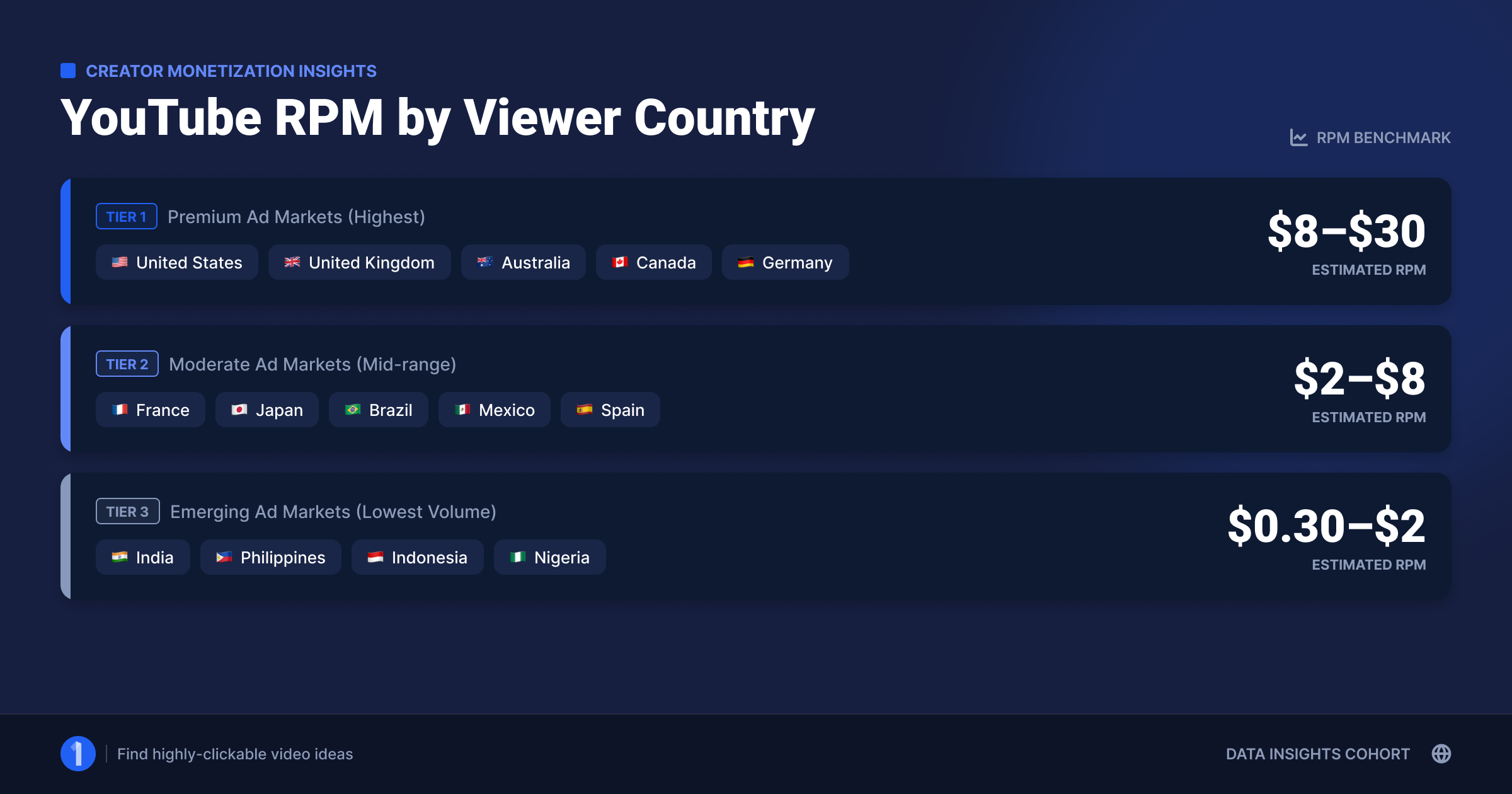
The second biggest lever is where your viewers are, because advertisers pay dramatically different rates in different ad markets. The same video, same niche, earns several times more from a US viewer than from a viewer in most of South and Southeast Asia, based on creator-reported analytics.
Typical pattern, expressed as tiers rather than false-precision figures:
| Viewer geography | Typical relative rate |
|---|---|
| US, UK, Canada, Australia | Highest tier; the benchmark most published RPM figures assume |
| Western and Northern Europe | Close behind the top tier |
| Eastern Europe, Latin America | Roughly a third to a half of top-tier rates |
| India, Pakistan, Philippines, most of Southeast Asia and Africa | Often a fifth to a tenth of top-tier rates |
Practical consequences:
- Audience geography explains most "why is my RPM low?" mysteries. A finance channel with 70% of views from low-CPM markets can earn less per 1,000 than a vlog watched mostly in the US.
- Language choices are revenue choices. English-language content aimed at US search queries tends to pull top-tier geography by default.
- You cannot fully control it, but you can influence it. Topics, titles, and posting times all shift which audiences find you.
Check your own split in YouTube Studio under Analytics, Audience, Top geographies. That one report tells you which tier your real RPM is anchored to.
How much does YouTube pay per view for Shorts?
Shorts run on a completely different payment model, and the rates are far lower. There is no per-video ad revenue. YouTube pools the ad money shown between Shorts each month, splits out music licensing costs, allocates the Creator Pool by each creator's share of engaged views, and pays you 45% of your allocation.
The practical numbers: creators typically report Shorts RPMs of roughly $0.04 to $0.15 per 1,000 engaged views. That is fractions of a cent per view, or around 1% to 5% of typical long-form rates. A Short with 1 million views commonly earns $40 to $150.
Three rules that follow from the model:
- Views only count if they are engaged views. Instant swipe-pasts pay nothing.
- Music use shrinks the pool share tied to your Short, not your 45%. No music keeps 100% of the associated revenue in the creator side of the split; one track cuts it to 50%.
- Shorts are a growth engine, not an income engine. The winning pattern is Shorts for reach, long-form for revenue.
We keep this section short deliberately, because we have a full teardown of the pool model, engaged views, and real payout examples in how much YouTube pays Shorts creators. The mechanics also gate on Partner Program acceptance and the Shorts Monetization Module, covered in the YPP guide.
What moves your RPM up or down?
Your RPM is not fixed. It moves with your content and the calendar. If you know the levers, month-to-month swings stop being mysterious and some become plannable.
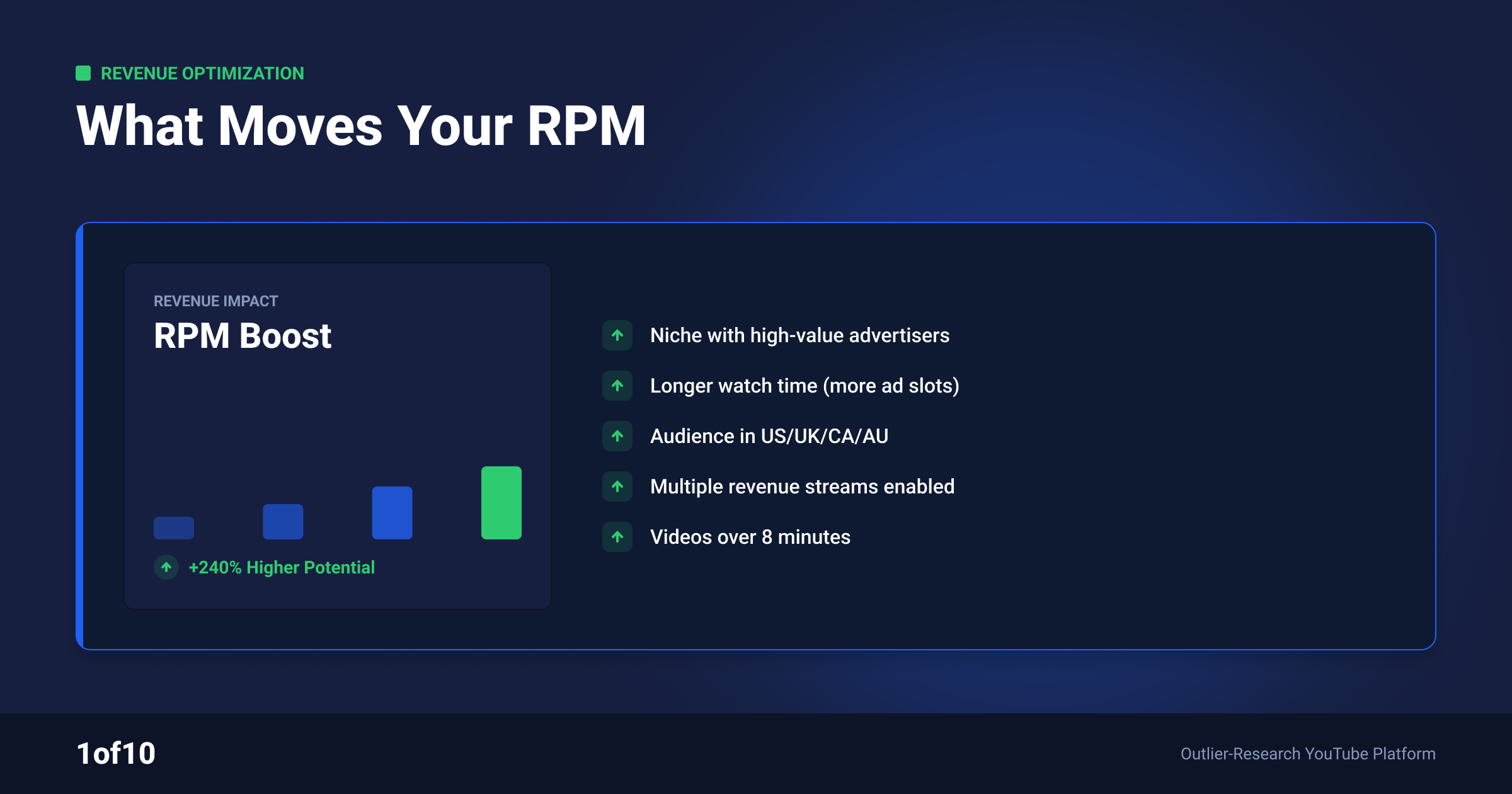
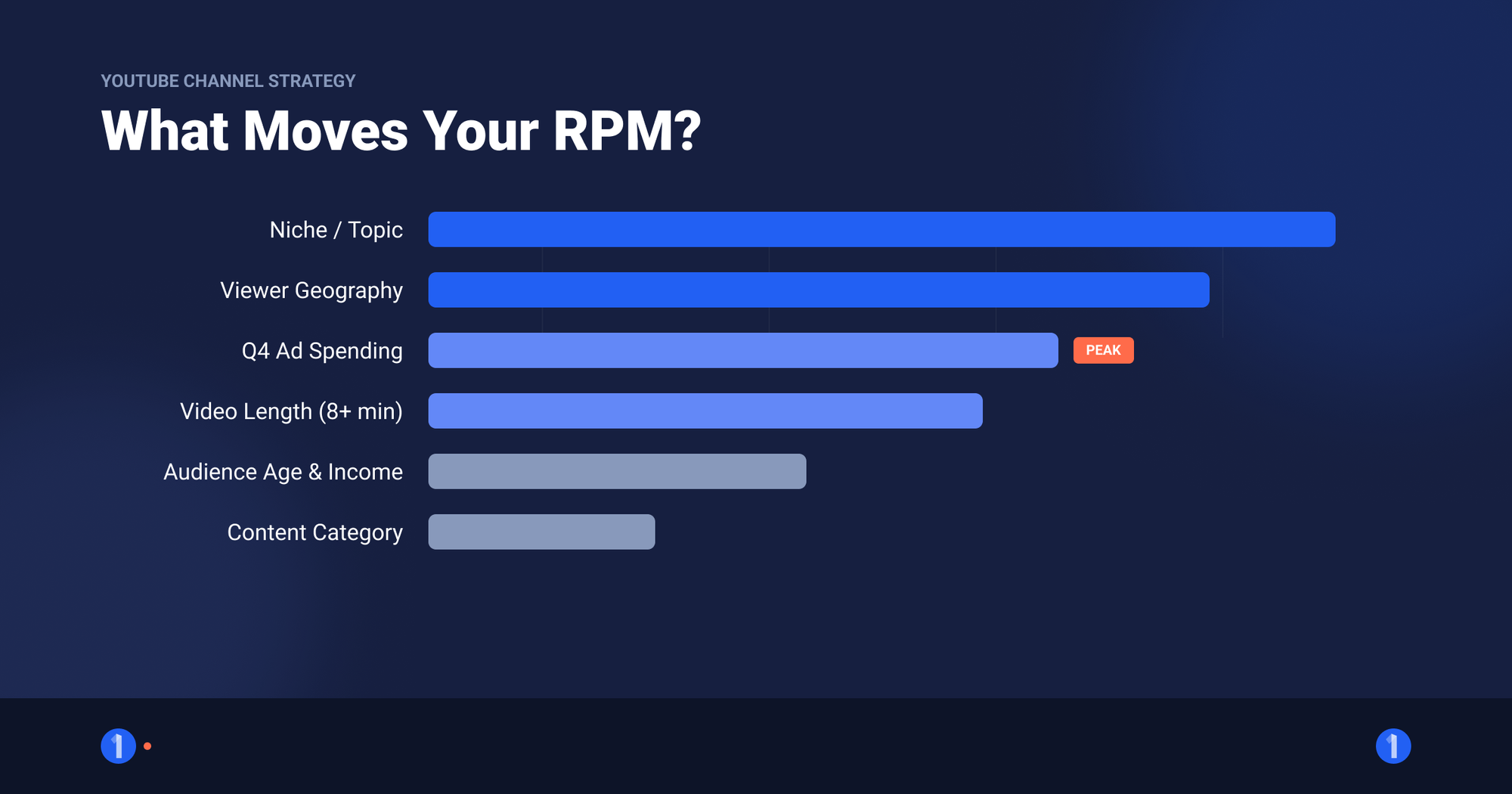
The levers, in rough order of impact:
- Niche and topic. The table above. Even within a channel, a video about "best budgeting apps" typically out-earns a storytime vlog per view because it attracts higher advertiser bids.
- Viewer geography. The tier table above. Shifts in where a video travels shift its rate.
- Video length and midrolls. Videos 8 minutes and longer can run midroll ads. More ad slots per view lifts RPM, which is why so many creators format long-form content past the 8-minute line.
- Q4 seasonality. Advertiser budgets surge before the holidays. Creators routinely report RPM peaking in November and December, then dropping sharply in January when budgets reset. A 20% to 40% seasonal swing is commonly reported. Plan big releases for Q4, not early January.
- Advertiser-friendliness. Videos rated for limited ads earn a fraction of their potential. Profanity in the first minute, violence, and borderline topics all trigger it.
- Viewer age and intent. Audiences with buying power attract higher bids. Search-driven views often monetize better than feed-driven views because intent is visible to advertisers.
None of these levers require more views. That is the point: RPM work and view growth compound each other, but they are separate jobs.
Worked examples: from views to dollars
The formula for every example: views x RPM / 1,000 = earnings. All RPMs below are from the typical creator-reported bands above.
Example 1: gaming channel, 1,000,000 monthly views. At a $3 RPM: 1,000,000 x 3 / 1,000 = $3,000 per month in ad revenue. Range across the $2 to $5 gaming band: $2,000 to $5,000.
Example 2: finance channel, 100,000 monthly views. At a $15 RPM: 100,000 x 15 / 1,000 = $1,500 per month. One tenth of the gaming channel's views, half its income. Niche is the multiplier.
Example 3: vlog channel, 250,000 monthly views. At a $2 RPM: 250,000 x 2 / 1,000 = $500 per month. The same views in the education band at $6 would be $1,500. Same effort, different lane.
Example 4: Shorts creator, 5,000,000 monthly engaged views. At a $0.07 Shorts RPM: 5,000,000 x 0.07 / 1,000 = $350 per month. Five million views, coffee-budget money. This is why Shorts-first channels convert attention into long-form watchers.
Example 5: mixed channel, 400,000 long-form views at $4 plus 2,000,000 Shorts views at $0.08. Long-form: $1,600. Shorts: $160. Total: $1,760, with 91% of the money coming from 17% of the views.
Run your own numbers, with your own view counts and niche band, in the free YouTube money calculator. For the method behind channel-level estimates, including how to estimate someone else's channel from public data, see our YouTube earnings calculator guide.
How many views do you need to earn $100 or $1,000?
Flip the formula and the question answers itself: views needed = target earnings / RPM x 1,000. The $100 figure matters doubly because it is also AdSense's minimum payout threshold; nothing hits your bank before you cross it.
Views required at typical creator-reported RPMs:
| Target | At $2 RPM | At $5 RPM | At $15 RPM |
|---|---|---|---|
| $100 | 50,000 views | 20,000 views | about 6,700 views |
| $1,000 | 500,000 views | 200,000 views | about 66,700 views |
| $5,000 | 2,500,000 views | 1,000,000 views | about 333,300 views |
The takeaways:
- A finance channel can hit its first payout on one modest video. 6,700 views is a normal week for a small channel with a searchable topic.
- An entertainment channel needs a genuine hit or steady volume. 50,000 views for the first $100 is why low-RPM niches feel slow early on.
- On Shorts rates, the same $100 takes roughly 1 to 2.5 million engaged views. The pool model is a reach machine, not a payout machine.
These view targets are also planning targets. If your niche needs 200,000 monthly views to pay $1,000, your content strategy question becomes concrete: which topics in this niche have proven they can pull that volume for channels your size?
Views are the input you control
Rates set the value of a view. Views set the size of the check, and views respond to research faster than rates respond to anything.
Across 1of10's outlier database, the videos that break out are outliers: they perform 10x to 100x above their channel's average. When a channel your size lands one, the topic and packaging did the work, not the audience. That makes outliers the most direct evidence of what your niche will click on right now.
The revenue-focused workflow:
- Find proven topics with the Outlier Finder, filtered to your niche and channel size.
- Check the niche's rate band in the tables above so you know what those views would pay.
- Package for the click. Titles and thumbnails decide CTR, and CTR decides impressions. Model both on outliers rather than guessing.
- Watch your real RPM in Studio and replace the typical bands with your actual number after a few months of data.
A $5 RPM channel that doubles its views beats a $5 RPM channel that spends the quarter chasing a $6 RPM. Do the rate work once, then put the effort where the payoff compounds: making videos with evidence behind them.
FAQ
How much does YouTube pay for 1,000 views?
Typically $1 to $20 for long-form videos, with most channels earning $2 to $5 per 1,000 views, based on creator-reported RPM ranges. Finance and business channels reach $10 to $30. Shorts pay far less, usually $0.04 to $0.15 per 1,000 engaged views from the Creator Pool.
How much money is 1 million views worth on YouTube?
Roughly $1,000 to $20,000 for long-form content depending on niche and audience geography, with $2,000 to $5,000 typical for mid-range niches. The same million views on Shorts is usually worth $40 to $150. These are typical creator-reported ranges, not guarantees.
How much does a YouTuber earn per view?
About $0.001 to $0.02 per long-form view, which is the per-1,000 RPM range of $1 to $20 expressed per view. High-value niches with US-heavy audiences sit at the top. Shorts earn fractions of a cent per view under the pooled revenue model.
Do you get paid per view without monetization?
No. Ad revenue only flows once you are accepted into the YouTube Partner Program at the 1,000-subscriber tier and you pass AdSense's $100 payout threshold. Before that, YouTube can run ads on your videos and keeps 100%. Requirements are in our YouTube Partner Program guide.
Why is my RPM lower than my CPM?
Because CPM measures what advertisers pay per 1,000 ad impressions, before YouTube's 45% share, and RPM measures your take per 1,000 total views, including views that showed no ad. Ad blockers, skips, and limited-ads videos all add zero-revenue views, so RPM always lands below CPM.
Your rate is mostly set by your niche. Your views are not. The 1of10 Outlier Finder surfaces the videos already doing 10x to 100x their channel's average, so your next upload starts from proof. Model the payoff first with the free YouTube money calculator. Start free at 1of10.com.
Related: How Much Does MrBeast Make a Year? 2026 Data Breakdown