
YouTube CPM and RPM by Niche: 2026 Rate Tables
YouTube CPM ranges from $2 to $50+ depending on niche. See 2026 CPM and RPM tables for 18 niches, geo multipliers, and 6 ways to raise your RPM.
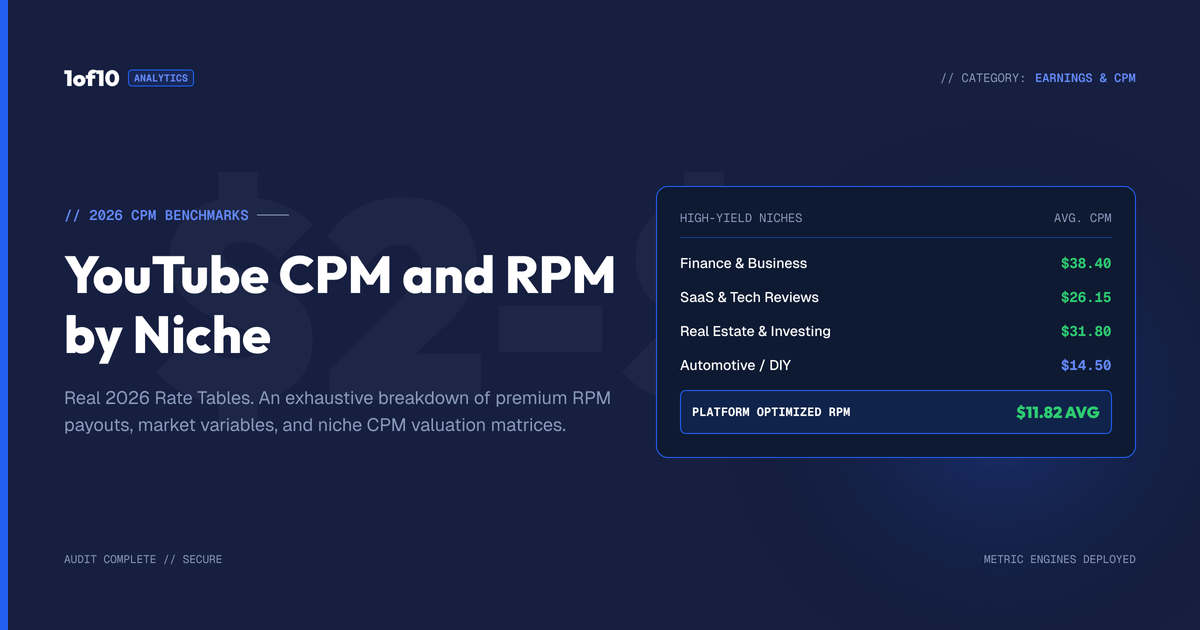
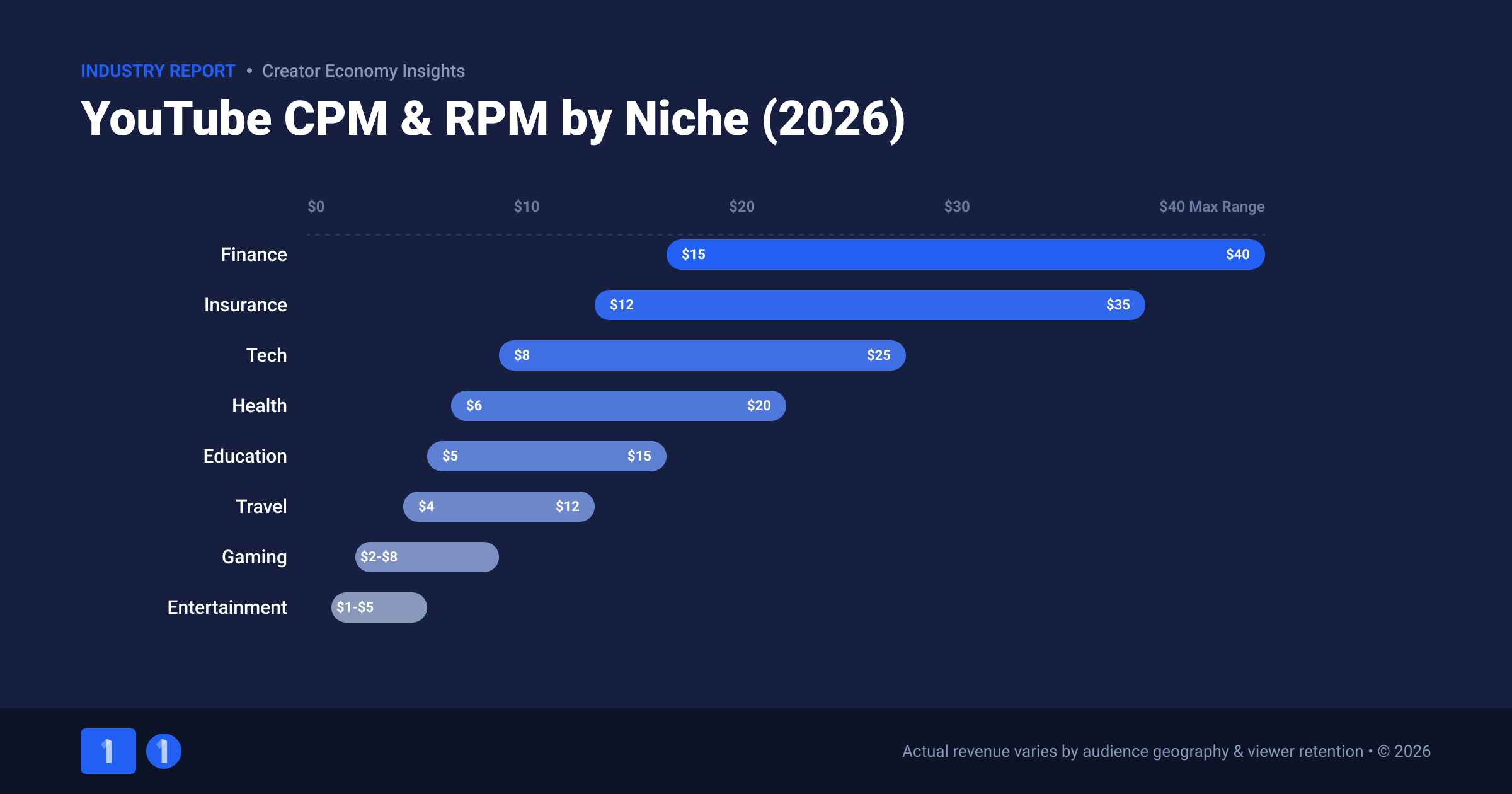
YouTube CPM in 2026 typically runs between $4 and $12 for most niches, while finance channels see $20 to $50+ and gaming channels sit near $2 to $6. Your RPM, the number you actually keep per 1,000 views, usually lands at 35 to 55 percent of your CPM after YouTube takes its 45 percent share of ad revenue.
That gap between CPM and RPM confuses more creators than any other number in YouTube Studio. Two channels with identical view counts can earn 10x apart based on niche and audience geography alone. Across industry RPM data, a 5x to 10x gap separates the top niche from the bottom.
This guide covers the exact difference between CPM and RPM, rate tables for 18 niches, geo multipliers, seasonality, and the levers that actually move your RPM. If you want the broader question of what YouTube pays per view answered first, start with our guide to how much YouTube pays per view, then come back here for the niche-level detail.
What Is YouTube CPM?
CPM stands for cost per mille, the amount advertisers pay for 1,000 ad impressions on your videos. YouTube CPM measures what brands bid for your audience, not what you earn. It is calculated before YouTube's revenue split, and it only counts monetized playbacks, meaning views where an ad actually served.
Three things follow from that definition:
- CPM is an advertiser-side number. It reflects how much your viewers are worth to brands.
- Not every view counts. A viewer with an ad blocker, or a view where no ad served, is excluded from CPM math.
- High CPM does not equal high earnings. A $40 CPM on a video where only 30 percent of views are monetized can pay less than a $10 CPM with 80 percent monetized playbacks.
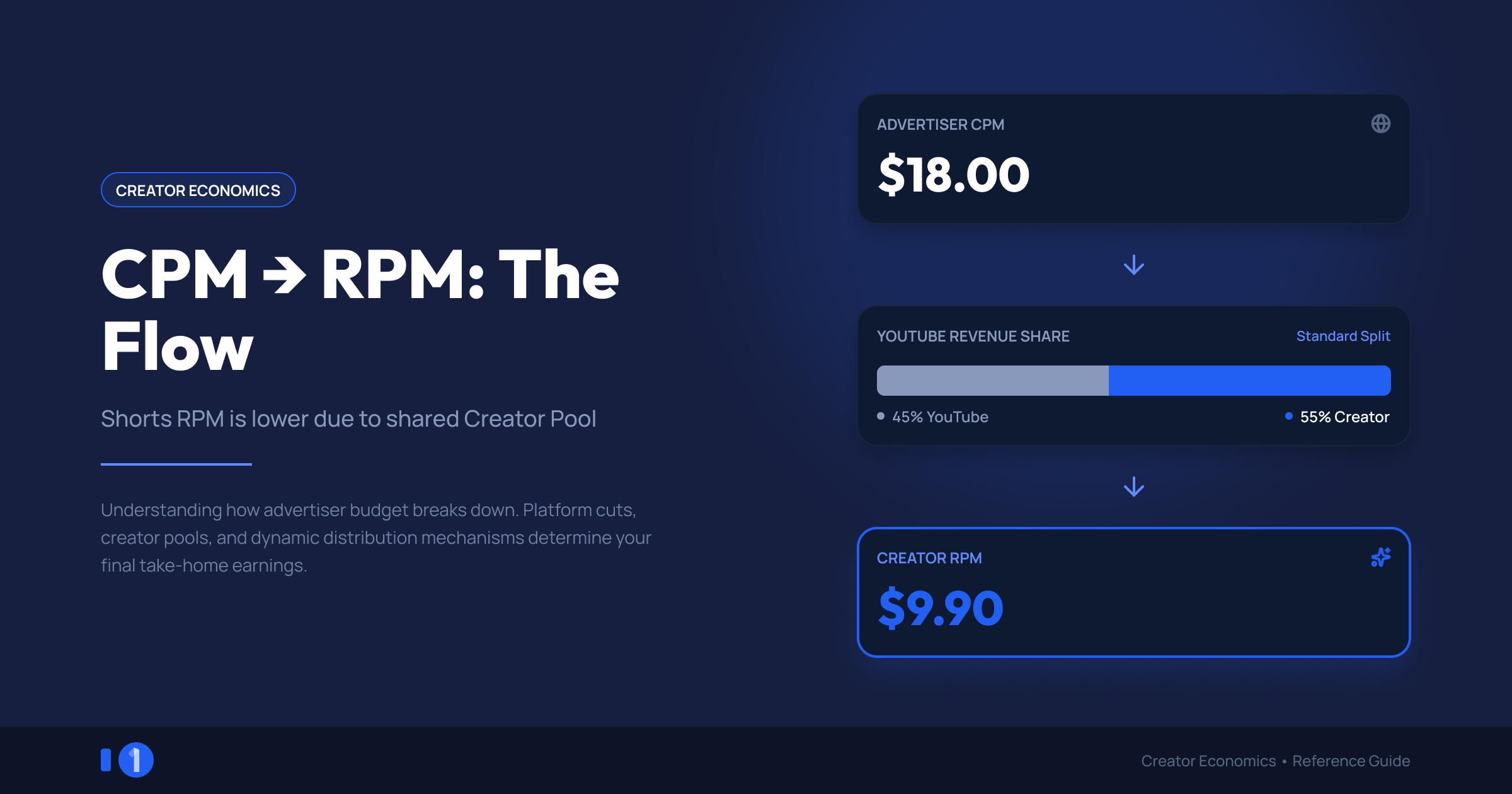
YouTube pays creators 55 percent of long-form ad revenue and keeps 45 percent, per YouTube's official Partner Program terms. Shorts use a separate pooled model with a 45 percent creator share.
What Is RPM on YouTube and How Is It Different?
RPM stands for revenue per mille: your total revenue per 1,000 views, after YouTube's cut, across every view on the video. RPM includes ad revenue plus memberships, Super Thanks, Super Chat, and YouTube Premium payouts. It is the only number in Studio that answers "what do I actually earn per 1,000 views?"
The two metrics differ on three axes:
| CPM | RPM | |
|---|---|---|
| Whose number | Advertiser cost | Creator revenue |
| Views counted | Monetized playbacks only | All views |
| YouTube's 45% cut | Before the cut | After the cut |
| Revenue sources | Ads only | Ads + Premium + memberships + Supers |
Quick rule: RPM is always lower than CPM. If your RPM ever looks higher than your CPM in a report, you are comparing different date ranges or different videos.
The Math Between CPM and RPM: A Worked Example
Take a channel that pulls 500,000 views on a video in a month. Here is how a $10 CPM becomes a $3.60 RPM:
- 500,000 total views, of which 300,000 are monetized playbacks (60 percent is a typical monetization rate for advertiser-friendly long-form content).
- Gross ad revenue: 300,000 ÷ 1,000 × $10 CPM = $3,000.
- Creator share after YouTube's 45 percent: $3,000 × 0.55 = $1,650.
- Add $150 from Premium, memberships, and Super Thanks: $1,800 total.
- RPM: $1,800 ÷ 500,000 × 1,000 = $3.60.
So a $10 CPM produced a $3.60 RPM, a 36 percent conversion. Most channels land between 35 and 55 percent depending on monetized playback rate and non-ad revenue. Run your own numbers through our free YouTube money calculator to see the same math on your views.
YouTube CPM and RPM by Niche: The 2026 Table
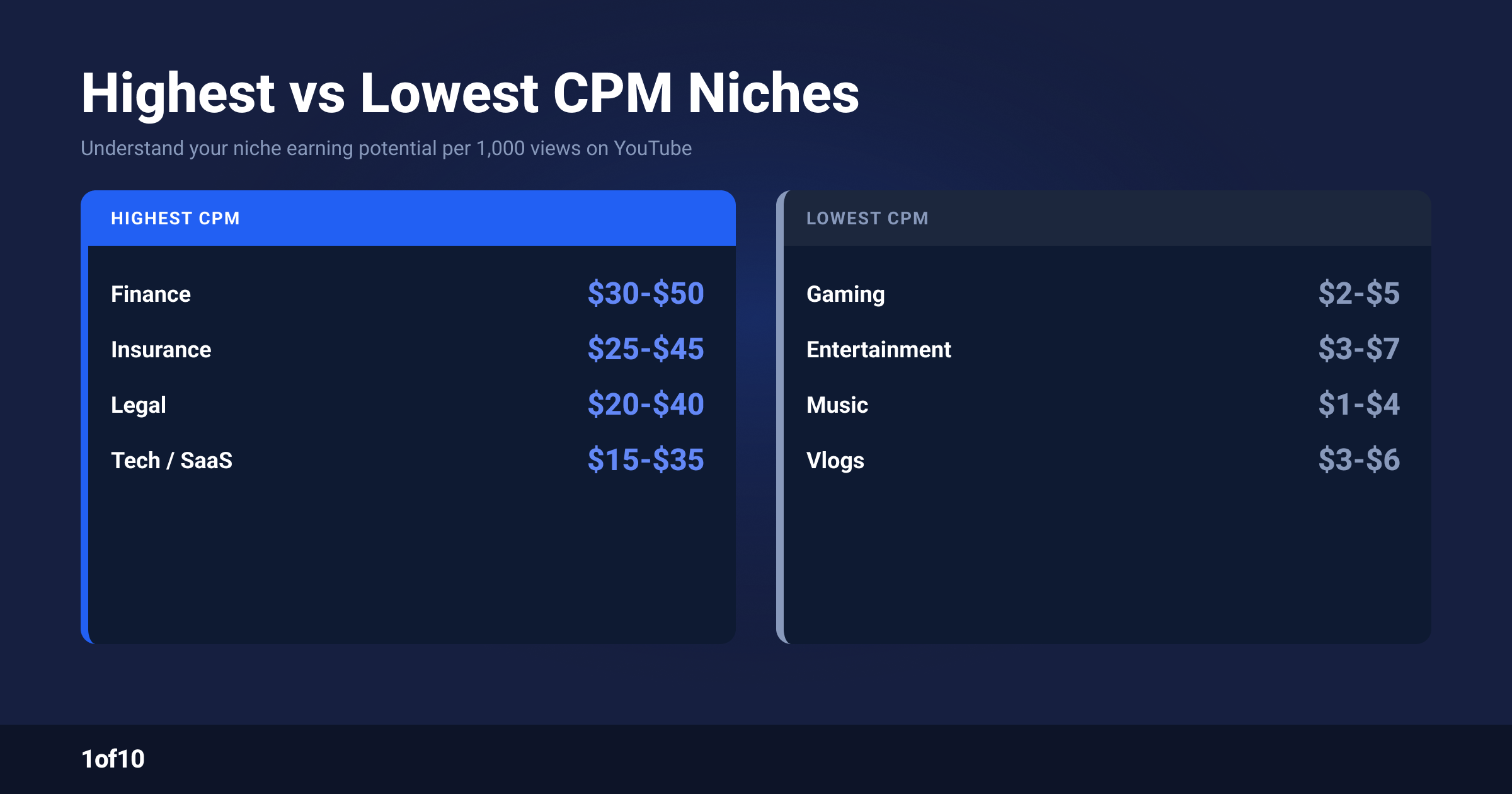
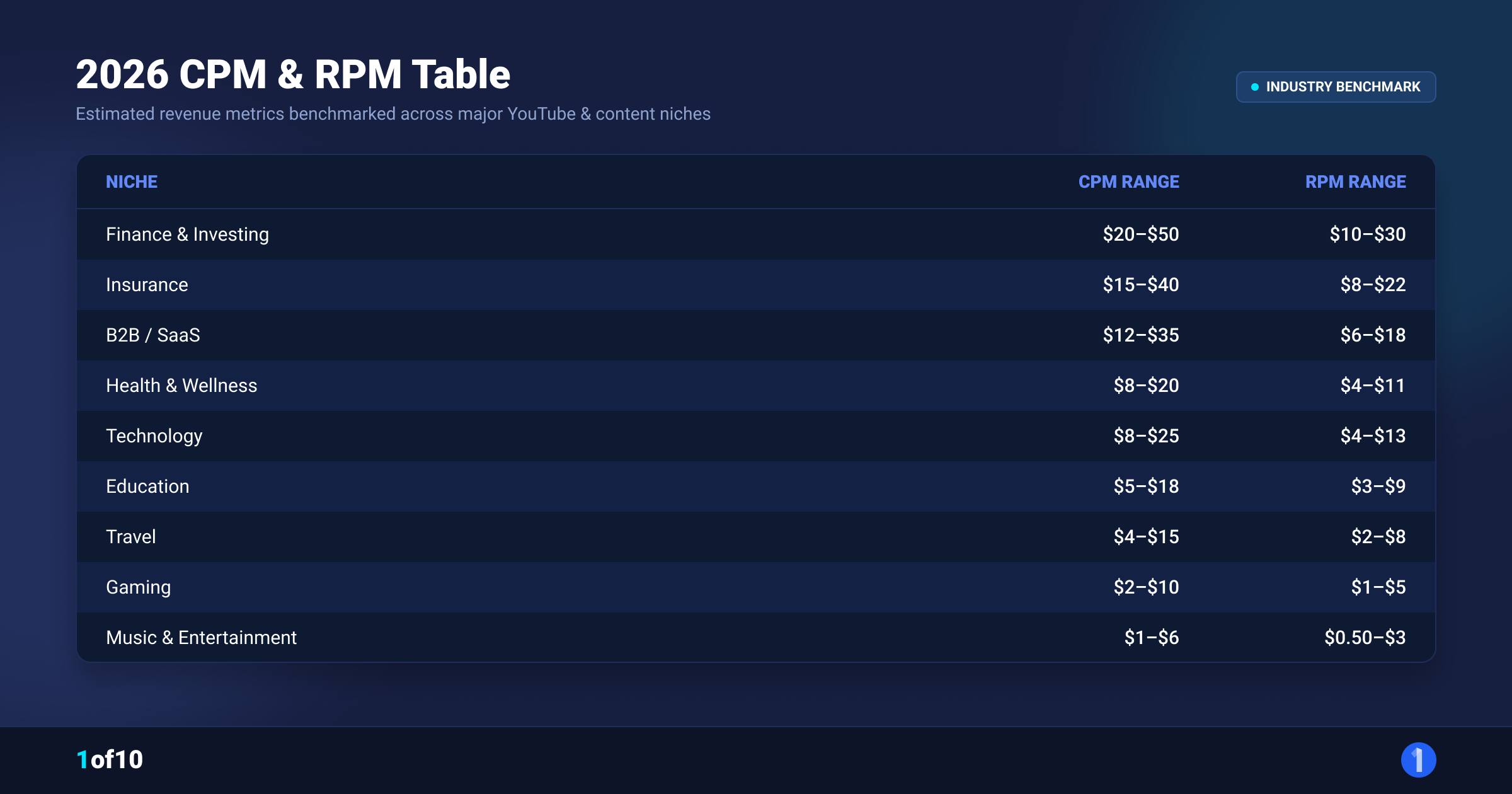
Advertiser demand sets the rates, so niches tied to money, software, and high-ticket purchases pay the most. The ranges below are typical figures compiled from public creator-reported data and industry rate reports. Treat them as directional bands, not guarantees. Your exact numbers depend on audience geography, video length, and season.
| Niche | Typical CPM (long-form) | Typical RPM (long-form) |
|---|---|---|
| Finance and investing | $20 to $50+ | $8 to $20 |
| Insurance and legal topics | $20 to $60 | $8 to $25 |
| Business and entrepreneurship | $15 to $40 | $6 to $16 |
| Digital marketing | $15 to $35 | $6 to $14 |
| Real estate | $12 to $30 | $5 to $12 |
| Tech and software reviews | $8 to $20 | $4 to $9 |
| Education and explainers | $6 to $15 | $3 to $7 |
| Health and fitness | $6 to $14 | $2.50 to $6 |
| Personal development | $6 to $14 | $2.50 to $6 |
| Automotive | $5 to $12 | $2 to $5 |
| Travel | $4 to $10 | $2 to $4 |
| Beauty and fashion | $4 to $10 | $1.50 to $4 |
| DIY and home improvement | $4 to $10 | $2 to $4.50 |
| Food and cooking | $3 to $8 | $1.50 to $4 |
| Lifestyle and vlogs | $3 to $7 | $1.20 to $3 |
| Gaming | $2 to $6 | $1 to $3 |
| Entertainment and comedy | $2 to $5 | $0.80 to $2.50 |
| Music | $1 to $4 | $0.50 to $1.50 |
All figures are typical ranges for majority-US audiences. Finance and insurance clear $15 to $35 RPM while gaming and entertainment sit near $2 to $5. Industry benchmark: finance videos earn roughly $15 to $35 RPM against gaming's $2 to $5, even at similar view counts.
Two notes on reading this table:
- The insurance and legal band looks spectacular but the ad inventory is thin. A mortgage-comparison video can hit a $60 CPM on 20,000 views while the rest of the channel sits at $12.
- Kids-directed content is its own case. "Made for kids" videos lose personalized ads and comments, which typically cuts CPM to $1 to $4 regardless of topic.
Why Do Finance Channels Earn 10x More Than Gaming Channels?
Customer value drives the gap. A bank acquiring one brokerage customer can earn thousands in lifetime revenue, so it will pay $40 per 1,000 impressions to reach investors. A mobile game earning $2 per install cannot bid anywhere near that. Your CPM is a mirror of what your viewers are about to spend money on.
The practical implications:
- Audience intent beats audience size. 100,000 views from people researching index funds out-earn 1,000,000 views from people watching meme compilations.
- You can shift CPM within your niche. A gaming channel covering "best gaming PC under $1,500" attracts hardware advertisers at 2 to 3x the CPM of a let's-play video, a pattern visible when you filter high-RPM formats in 1of10's Outlier Finder.
- Low-CPM niches monetize elsewhere. Entertainment channels typically earn more from YouTube sponsorship deals than from AdSense, because brands buy attention that advertisers underprice.
Geo Multipliers: Why Audience Location Changes Everything
The same video with the same niche pays wildly different rates depending on where viewers watch from. Advertisers bid on markets where their customers live, and US, UK, and Australian viewers command the highest bids. The multipliers below are typical ranges creators report against a US baseline.
| Audience country | Typical CPM multiplier vs US |
|---|---|
| United States | 1.0x (baseline) |
| Australia | 0.9x to 1.1x |
| United Kingdom | 0.8x to 1.0x |
| Canada | 0.8x to 1.0x |
| Germany, Nordics | 0.7x to 0.9x |
| Japan, South Korea | 0.5x to 0.8x |
| Brazil, Mexico | 0.2x to 0.35x |
| India, Philippines, Pakistan | 0.05x to 0.15x |
A finance channel with 80 percent Indian viewership can earn less per view than a gaming channel with 80 percent US viewership. If your topic travels globally, your RPM will drift toward your audience map, not your niche's headline rate. Check Studio's geography report before you blame your niche.
When Do YouTube CPMs Rise and Fall? Seasonality Explained
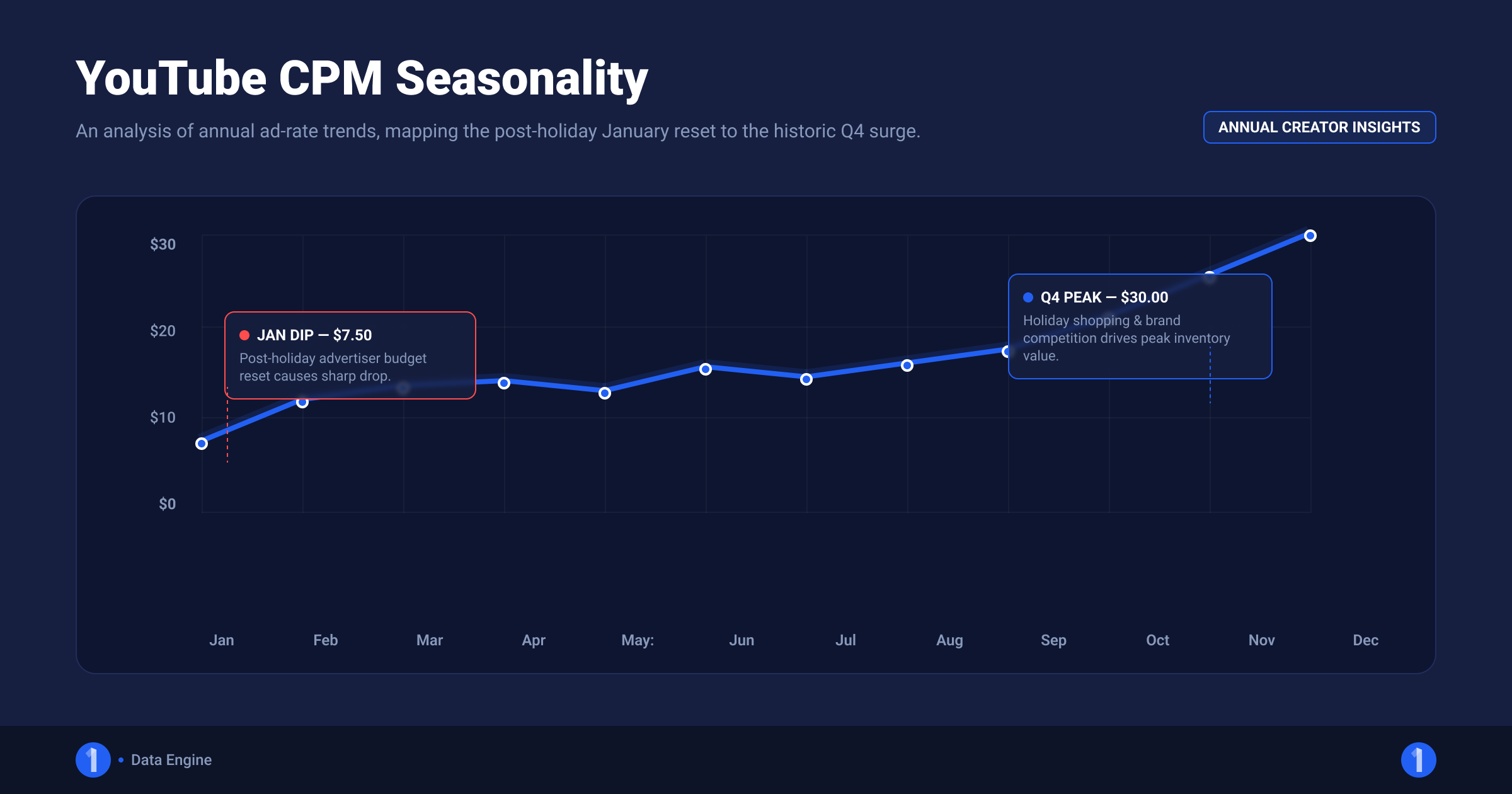
CPMs follow advertiser budget cycles: they peak in Q4 and crater in January. Brands spend hardest into Black Friday and the holidays, then annual budgets reset and January auctions go quiet. Creators commonly report swings of 20 to 40 percent between the Q4 peak and the Q1 trough, a typical range rather than a fixed rule.
The quarterly pattern:
- Q1 (Jan to Mar): the dip. Budgets reset, bids fall. Your revenue drop in January is normal, not a penalty.
- Q2 (Apr to Jun): steady recovery as new budgets deploy.
- Q3 (Jul to Sep): flat to rising, with a back-to-school bump for education and tech.
- Q4 (Oct to Dec): the peak. Holiday retail bids push CPMs to their annual high.
Plan around it. Publish your most monetizable long-form content in Q4 when every impression pays more, and use Q1 for experiments, channel cleanup, and formats you are testing.
How to Find Your CPM and RPM in YouTube Studio
Your real numbers beat any benchmark table. YouTube Studio shows both metrics per channel and per video, and checking them takes under a minute once you know the path. You need to be in the YouTube Partner Program to see revenue data, which requires 1,000 subscribers plus 4,000 watch hours or 10 million Shorts views, per YouTube's eligibility docs.
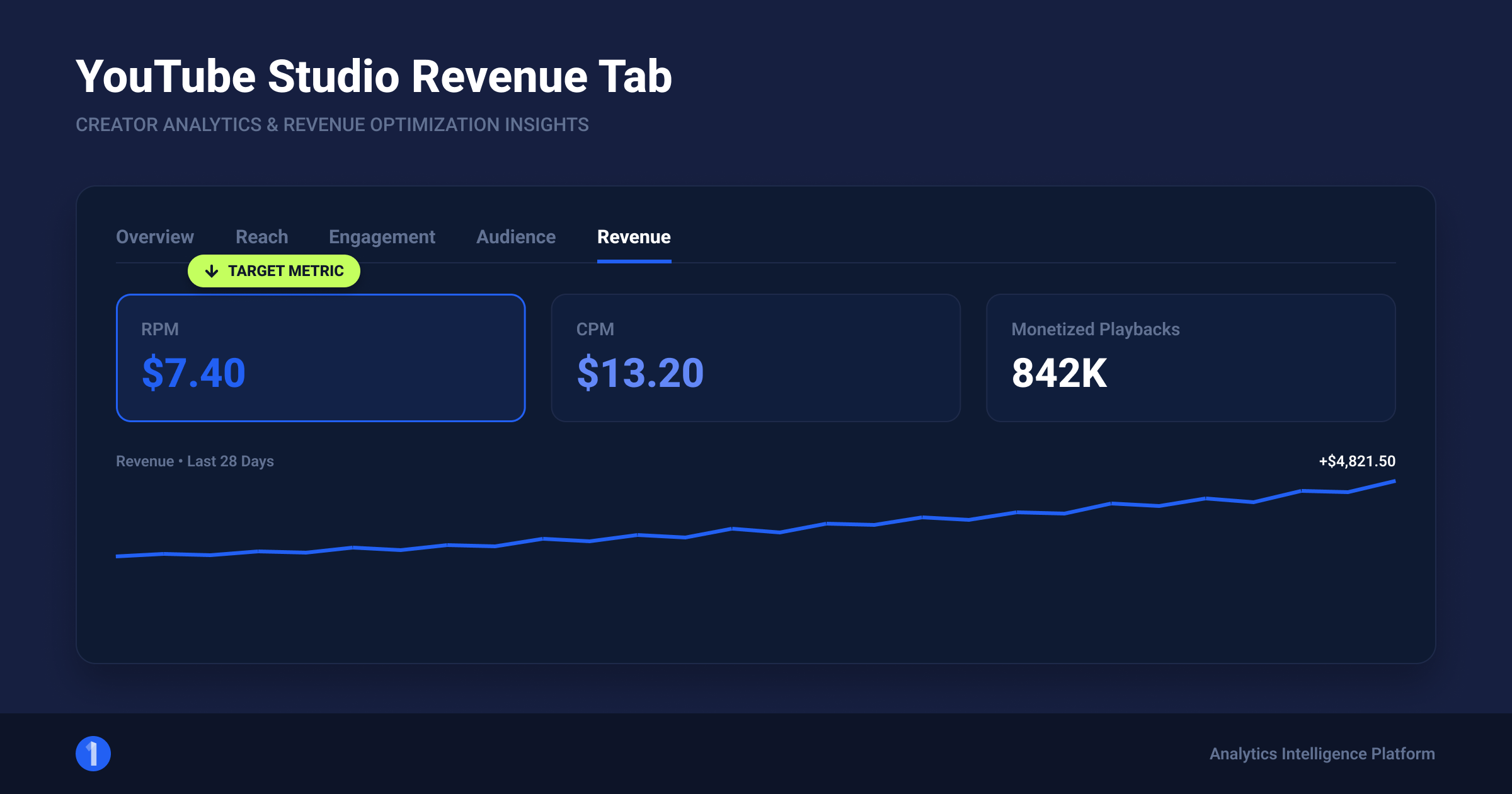
Steps:
- Open YouTube Studio and click Analytics in the left menu.
- Select the Revenue tab. RPM and playback-based CPM appear as cards at the top.
- Click any card to expand the trend line and change the date range. Compare Q4 against Q1 to see your own seasonality.
- Scroll to Top-earning videos to spot which topics pull your highest RPM.
- Open Advanced mode, add the Geography dimension, and sort by revenue to see your geo mix.
Not monetized yet? Our YouTube Partner Program guide covers the thresholds and the fastest routes to hitting them.
How Do You Increase Your YouTube RPM?

You cannot negotiate with the ad auction, but you can change what you feed it. RPM responds to topic selection, video length, audience geography, and format mix. These six levers are ordered by impact.
- Pick higher-value topics inside your niche. Every niche has a CPM spread. Use outlier research to find which formats in your niche earn and get views: filter your niche in 1of10's Outlier Finder for videos performing 10x their channel average, then study which of those topics carry commercial intent. Across industry RPM data, commercial-intent topics like finance and B2B tech pull $15 to $35 RPM versus $2 to $5 for pure entertainment.
- Cross 8 minutes and place mid-rolls. Videos over 8 minutes qualify for mid-roll ads, which multiply ad impressions per view. Two or three well-placed mid-rolls at natural breaks typically raise RPM without hurting retention. Do not pad a 6-minute idea to 9 minutes; retention losses cost more than mid-rolls pay.
- Court high-CPM geographies. English-language content, US-relevant topics, and US-hour publishing times shift your geo mix toward the 1.0x column above.
- Stay advertiser-friendly. Limited ads from profanity in the first minute, violence, or borderline thumbnails cut monetized playback rate directly. That 60 percent figure in the worked example can fall to 20.
- Balance Shorts and long-form. Shorts build reach but pay a fraction of long-form rates (next section). Use Shorts to acquire viewers, long-form to monetize them.
- Stack non-ad revenue. Memberships, Super Thanks, and Premium watch time all flow into RPM. Channels with engaged communities routinely add 10 to 20 percent to RPM from these sources, a typical range.
For total-earnings planning across ads, sponsorships, and everything else, see our YouTube earnings calculator guide.
Shorts RPM vs Long-Form RPM: The Real Gap
Shorts pay far less per view than long-form. Creators commonly report Shorts RPMs of $0.05 to $0.10 per 1,000 views, against $1 to $20+ for long-form. That is not a bug: Shorts revenue is pooled across all Shorts, adjusted for music licensing, then paid out at a 45 percent creator share per YouTube's Shorts monetization docs.
What this means in practice:
- 1,000,000 Shorts views at a $0.07 RPM pays about $70.
- 1,000,000 long-form views at a $3.60 RPM pays about $3,600, roughly 50x more.
- Niche matters less for Shorts. The pooled model flattens the finance-vs-gaming gap that dominates long-form.
- Shorts earn their keep as a funnel. Their job is subscribers and session starts, and 1of10's Shorts Outliers shows which Shorts formats are converting viewers right now.
FAQ
What is a good CPM on YouTube?
A good YouTube CPM depends on your niche. For most mid-value niches like education, fitness, and tech, $8 to $15 is solid. Finance and business channels should expect $20+, while gaming and entertainment channels are doing fine at $4 to $6. Compare against your niche's band, not the platform-wide average.
Why is my RPM so low?
Low RPM usually traces to one of four causes: a low-CPM niche, an audience concentrated in low-bid countries, videos under 8 minutes with no mid-rolls, or limited ads from advertiser-unfriendly content. Check Studio's geography report and your monetized playback rate first. Both explain more RPM variance than niche alone.
What is the average YouTube CPM in 2026?
Across all niches and geographies, average YouTube CPM typically falls between $4 and $12 for long-form content, based on creator-reported data. The average is close to meaningless for planning, though. The spread runs from under $1 for music content in low-bid regions to $60+ for US insurance topics.
Does YouTube pay per view or per ad impression?
YouTube pays from ad impressions, not raw views. Advertisers pay per 1,000 monetized playbacks (CPM), YouTube keeps 45 percent of long-form ad revenue, and your share spreads across all views as RPM. Our YouTube pay-per-view breakdown walks the per-view math end to end.
Which niche has the highest CPM on YouTube?
Finance, insurance, and legal topics carry the highest YouTube CPMs, with typical ranges of $20 to $60 for US audiences. Business, digital marketing, and real estate follow. The pattern holds because advertisers in these categories earn high lifetime value per customer and outbid everyone else for the same ad slot.
CTA block: Your niche sets your ceiling, but topic selection sets your floor. 1of10's Outlier Finder shows which videos in your niche are pulling 10x their channel average right now, so you can pick topics that earn views and dollars at the same time. Try 1of10 free.